
Tools that Sing
By Alixandra Rutnik on May 06, 2022
Sounding off with producer Gabriel Shalom
Unconventional percussion has quite a history in the ad world — all the way back to Heineken's 1980s "Bins" spot — and doing it effectively and beautifully can be quite an artform, one that producer and Young Guns 10 winner Gabriel Shalom has taken seriously over his career.
Ace Hardware tapped Gabriel to lend his talents towards making an orchestra out of its vast tool inventory. While that campaign aired last year, Gabriel recently released a behind-the-scenes video to show us how exactly they did what they did.
We talked to Gabriel about his podcast Creative Risk last time, and today we’re discussing his role in producing Carol of the Tools: Behind the Scenes of the Ace Holi-D.I.Y. Orchestra.
So, you are the Director/Producer/Editor for both the Ace Holi-d.i.y. Orchestra Campaign and the behind-the-scenes film. Where did this idea originate?

This project was the brainchild of OKRP Chicago’s creative directors David Petti, Mike Cornell, and Andy Sciamanna. OKRP have worked on the Ace brand for years. The project really couldn’t have happened without the solid foundation of their relationship with the client, because the truth is, Ace had never done anything like this before! The idea of making a Christmas carol entirely from the sounds of objects from an Ace Hardware store was selected as an idea that would encourage participation on social as well as generate some fun publicity – which it did!
How did you get on board?
One of my films – Warehouse Samba, an experimental dance film I made for Shure microphones – had caught the creative team’s eye. OKRP executive producer Scott Mitchell called me up and asked if I had some free time. The clock was ticking from our first call, and I was psyched about the treatment even though we had basically just a couple weeks to pull everything together. But what was really unique for me was to come into a project that already had a composer attached.
I wear many hats, and in a lot of my commercial directing work I also take credit for editing, producing, composing, and even some choreography. So the opportunity to collaborate with Beacon Street Studios and Danny Dunlap was an exciting prospect, because I was creating something fun and choreographic without also having to compose the music myself. On top of that, Danny has incredible musical skills that I simply do not possess. Working together with him felt like being on a dream team. The team altogether was just around 30 people including client, agency, production and postproduction.
Why did you decide to make a behind-the-scenes video?
People love to see how things work. The more complicated and magical the outcome, the more satisfying it can be to see behind the scenes and comprehend how it all comes together. So there’s that basic desire to give people more of a good thing.
But on top of that, and probably more fundamentally, is a desire I have as an executive producer to take care of my people as best as I can. Working the way I do, I don’t have traditional employees. My teams are assembled ad hoc, for this project with the help of Mandi Nodorft, a spectacular producer recommended by some good friends. And those teams are ephemeral.
A couple weeks of concentrated energy and coordination, with the crescendo of craft and creativity on set, giving way to the quiet and usually invisible postproduction process. A behind the scenes film gives all these talented individuals another chance to be seen. By our peers, by potential future collaborators, and maybe if we’re lucky, by future clients. Producing behind-the-scenes films is a small but significant thing we can do in our industry to counterbalance some of the precarity of working in the commercial side of film production.
Wrenches, yetis, grills, wood planks, etc. How many tools did the team test out during field research?
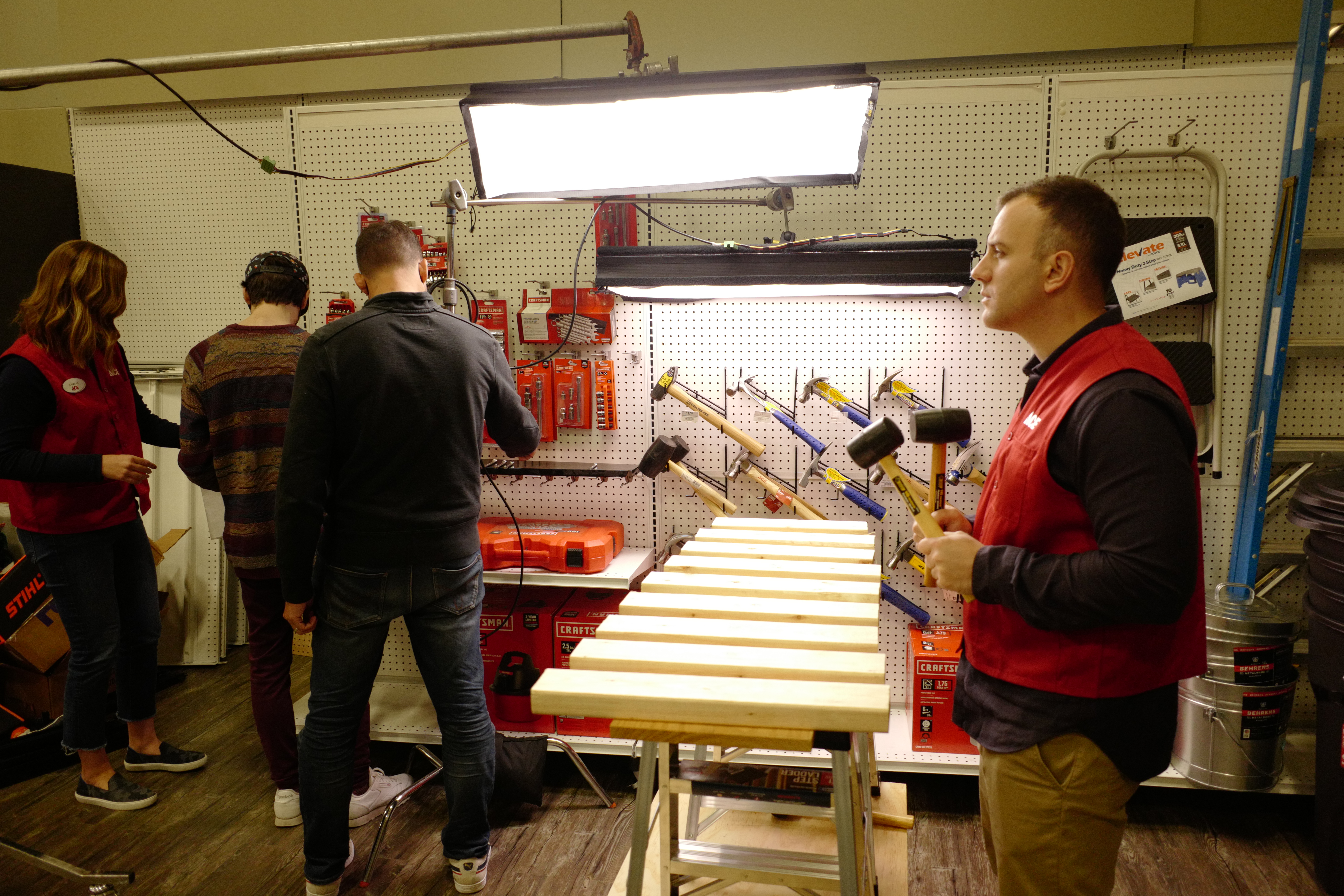
Danny “auditioned” dozens of tools over a period of several weeks. What became abundantly clear watching his process was that he wanted to find objects which would be able to serve as the various instrumental voices in the song. But beyond matching the sonic quality of those voices, Danny managed to meticulously tune the objects and turn them into playable homemade instruments – a la Blueman Group or STOMP – with musically accurate pitch intervals. And then he played the instruments like a boss! Just see what he does with the 2x4 marimba in the behind-the-scenes video during rehearsals – incredible.
There was definitely a culling down from Danny’s field tests to what ended up on the editing timeline. Beyond that, the process of storyboarding and shooting also narrowed the focus even more. For example, there was a beautiful bell/xylophone-like tone Danny created from some oddly ring-shaped saw blades. While that sound remained in the musical composition, the visual of the saw blades didn’t make it into the final shot list. That said, our shoot was very focused and concentrated, and only a very small percentage of tools which were shot didn’t make it into the final edit.
Altogether, how many items were used in the orchestra?
Off the top of my head I couldn’t name them all but I’ve been told it was 65 products. We’re talking wrenches, tumblers, leaf blowers, chainsaws, trashcans, Ace’s signature Big Green Egg barbeque grills, 2x4s, drills, screwdrivers, boxes of screws, coolers – you name it.
Let’s discuss the contraption with the ping pong ball– does it have a name?
It doesn’t have an official name, but unofficially I would have chosen to call it “Danny, Mike, Dave, and Andy’s Baby.” Those guys worked overtime to reconstruct the contraption on set from 2x4s and saw blades. They worked extra hard to calibrate it so we could capture the ping pong ball’s descent in one perfect take.
Danny joined us for the shoot and also lent his expertise to make sure the ball run worked like it did in the test footage he’d sent us. To be honest, I was skeptical about whether we would pull it off right up until we had the shot in the can. But looking back, I wouldn’t change a thing. It’s a brilliant moment and a great example of how the team’s collaboration yielded a superior outcome. I have nothing but gratitude for how stubbornly those guys were in insisting we’d manage to get the shot. They were right, and it was glorious!
Did you all rehearse for hours or days?
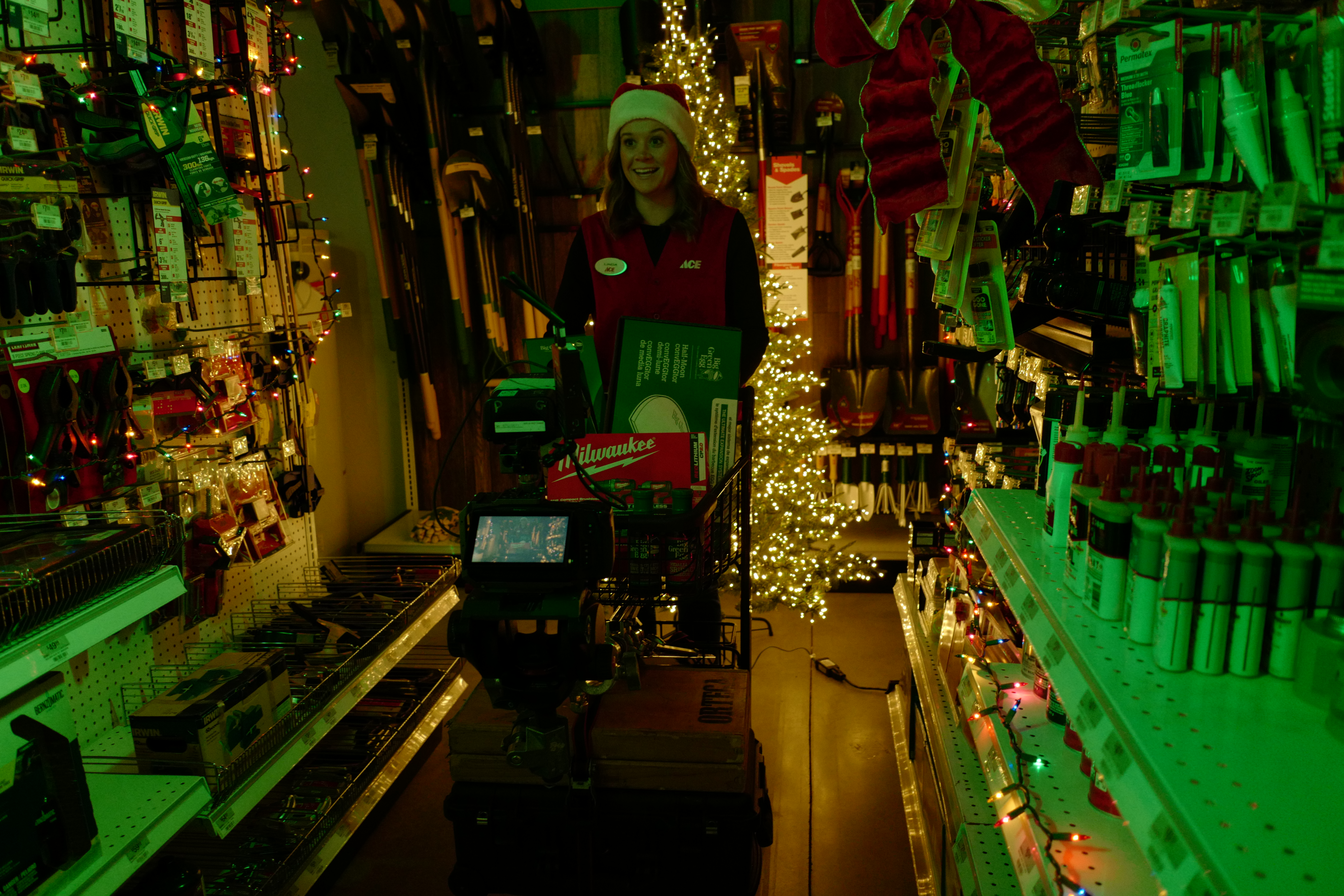
Rehearsal time? Surely you jest. We had one day of prep on set, but that was primarily spent making sure that all our props, set pieces, and art direction were thoroughly sorted out. Our art director Lena Rush Smith was instrumental in getting the location prepped for shooting. We were shooting in a special Ace Hardware store that is set up in a warehouse to look like a retail location, but it’s not. This afforded us the ability to shoot “on location” in aisles of products that were ready to go while also giving Lena the option to construct a small set piece that served as backdrop for half a dozen shots that looked as if they were filmed all over the store.
"We were shooting in a special Ace Hardware store that is set up in a warehouse to look like a retail location, but it’s not."
I also spent a lot of time working with our director of photography Bryan Mir blocking out the shot plan and camera positions to ensure a smooth shooting day, with our gaffer Spencer Ortega close by carefully planning the lighting instrumentation to simulate both in-store lighting as well as an alternate festive look enhanced by strings of Christmas lights.
Did you film the whole song at one time or did you film it in parts and then have to paste it together in the editing process?
We cast folks with some musical ability. The musical component was a matter of getting performances synced to playback and shooting was a lot like directing a music video. So I very much pieced it together shot by shot in the edit.
What was the most challenging obstacle in producing both the original campaign and the behind-the-scenes video?
The thing people might expect me to identify as a challenge was the casting process, because the truth is 100% of our on-screen performers were real Ace employees! But I have a lot of experience working with non-actors. I actually found it was quite easy to get them to warm up to the process and have a good time.
So at the end of the day, my biggest challenge was in completing the edit of the behind-the-scenes film. When you’re so close in on this sort of project and already wearing so many hats, it can be pretty tricky to have the ability to self reflect clearly. My assistant editor Leah Lubman was my go-to second set of eyes to get the necessary perspective. She has a remarkable storytelling ability, and although she is relatively new to video editing, she has an incredible literary background that gives her a really keen sense of character development and timing.
"When you’re so close in on this sort of project and already wearing so many hats, it can be pretty tricky to have the ability to self reflect clearly."
What was your favorite part of the job– directing, producing, or editing?
It’s hard for me to separate those things to be honest. Traditionally, the film world, whether commercial or narrative, likes to segregate those roles into different departments, different skill sets, and different line items in a budget. And while I totally understand the need to do it that way, I come at this sort of work from an entirely different background in video art.
All these roles get lumped together under the umbrella of the video artist, a lot of the time because of necessity. Video art budgets often don’t have affordances for these roles to be separated from the author of the work. While that probably sounds grueling from a traditional commercial filmmaking perspective, the incredible upside is that you get an extremely hands-on experience in all aspects of the craft of making moving images.
This is one reason why I make a good hybrid director/producer– I know what every stage of the process looks like, and I’ve had roles in marketing and business that allow me to frame the creative process in relation to the client’s needs as well. At the end of the day, if I can stay attached creatively and be part of the process from start to finish, it's when I’m at my best, because it allows me to embrace my natural state of being an artist.
"This is one reason why I make a good hybrid director/producer– I know what every stage of the process looks like, and I’ve had roles in marketing and business that allow me to frame the creative process in relation to the client’s needs as well."
One Club for Creativity Members get featured here on the One Club website and across our social media channels. Have a new project you'd love to share? An upcoming exhibition and you'd like us to help spread the word? Drop us a line at [email protected]. We always love to know what our One Club Members have been up to, so don’t forget to send us your cool work!



Related
.png)


