ADC Awards
ADC Annual Awards is the oldest continuously running industry award show in the world, with an incredible legacy of over 100 years. These awards celebrate the very best in advertising, digital media, graphic and publication design, packaging and product design, motion, experiential and spatial design, photography, illustration and fashion design – all with a focus on artistry and craftsmanship.
Learn more about ADC105
Category
Data Visualization
Annual ID
ADC104_INT016B
Background
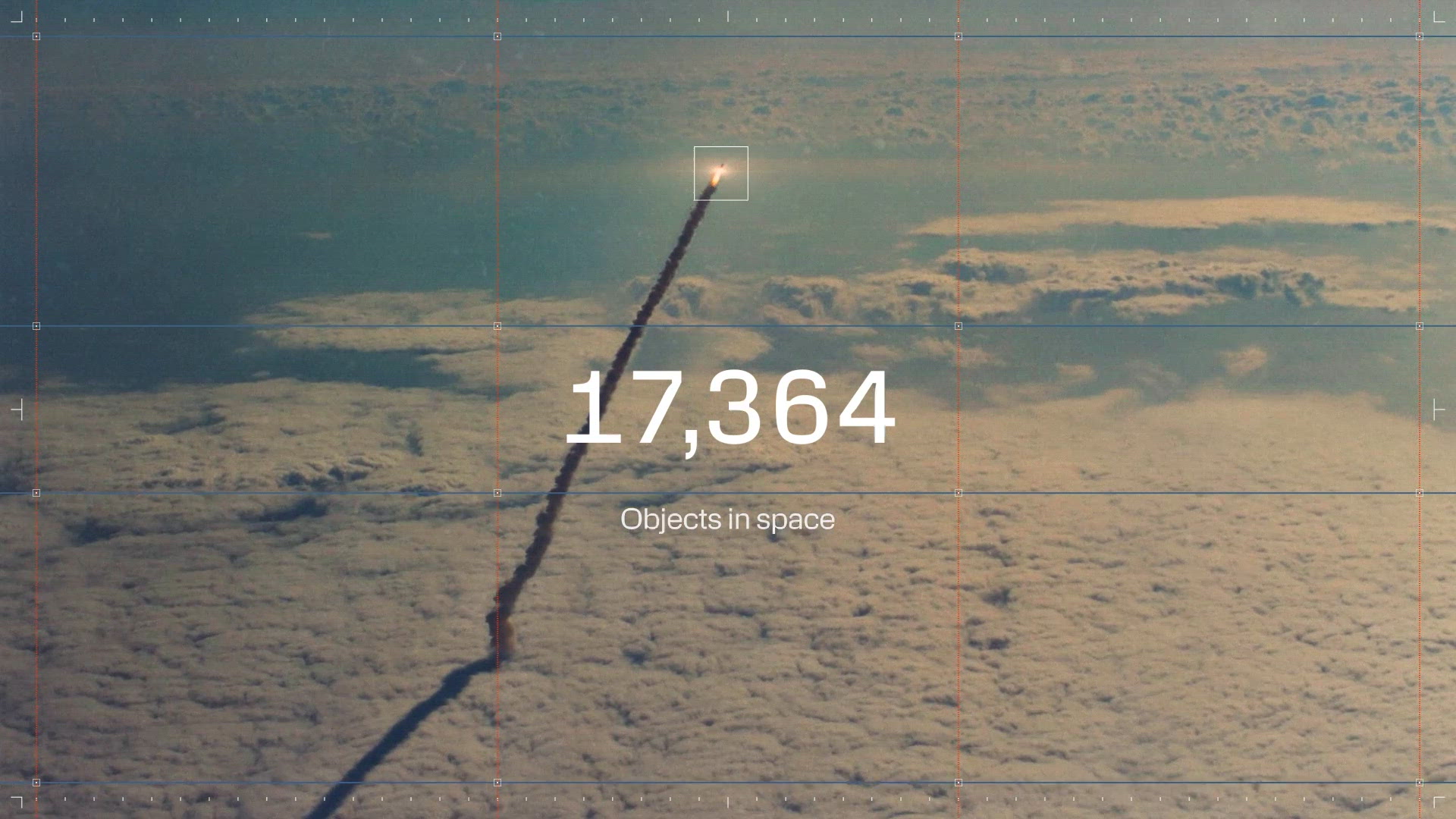
Background: More objects are being launched into space than ever, resulting in more trash in space than ever, which threatens the critical infrastructure that we all depend on, from communication to food production, and more. Despite the urgency, there are no legally binding international treaties that can enforce the cleanup of space debris.
Challenge: Aerospace company Privateer provides data for space trash removal and prevention. But the lack of public understanding allows the aerospace industry to turn a blind eye to pollution, undermining support for companies like Privateer.
Challenge: Aerospace company Privateer provides data for space trash removal and prevention. But the lack of public understanding allows the aerospace industry to turn a blind eye to pollution, undermining support for companies like Privateer.
Creative Idea
Insight: Privateer aggregates over 800 million data points about space objects and debris from public and private sources. But people still don’t understand the threat because space debris is not visible.
Idea: Space Trash Signs — visualizing the consequences of space pollution with the first constellations made from space debris. Millions of moving debris datapoints were scanned to identify ten new constellations, each one representing a different impact of space pollution. For example: The Broken Compass signifies the loss of navigation services; The Lost Harvest, visualized as a dying plant, stands for the loss of environmental data; The End of Discovery, in the shape of a stop sign, represents the end of space exploration.
Idea: Space Trash Signs — visualizing the consequences of space pollution with the first constellations made from space debris. Millions of moving debris datapoints were scanned to identify ten new constellations, each one representing a different impact of space pollution. For example: The Broken Compass signifies the loss of navigation services; The Lost Harvest, visualized as a dying plant, stands for the loss of environmental data; The End of Discovery, in the shape of a stop sign, represents the end of space exploration.
Insights & Strategy
Target audience: People worldwide, of all age groups, who have no technical background in aerospace or astronomy.
Key insight: Since the beginning of time, humans have looked up to the sky for meaning, and this act led to the formation of constellations as a way of understanding stars. Expanding on this insight, space debris was turned into constellations, with each symbol simplifying the various consequences of space pollution.
Media planning: To reach as many people as possible, the constellations were showcased as a digital experience. Further, the constellations were integrated into AR stargazing apps and planetariums as a way of disrupting touchpoints which are primarily used to educate about space. Space Trash Signs was launched in the critical time leading up to the UN COPUOS (United Nations Committee on the Peaceful Uses of Outer Space) session to increase engagement for a topic that’s kept out of the public eye.
Key insight: Since the beginning of time, humans have looked up to the sky for meaning, and this act led to the formation of constellations as a way of understanding stars. Expanding on this insight, space debris was turned into constellations, with each symbol simplifying the various consequences of space pollution.
Media planning: To reach as many people as possible, the constellations were showcased as a digital experience. Further, the constellations were integrated into AR stargazing apps and planetariums as a way of disrupting touchpoints which are primarily used to educate about space. Space Trash Signs was launched in the critical time leading up to the UN COPUOS (United Nations Committee on the Peaceful Uses of Outer Space) session to increase engagement for a topic that’s kept out of the public eye.
Execution
Process: An AI model was used to scan millions of data points based on shape, source object, and location. For example, to build The Broken Compass, the model was restricted to locating debris pieces from defunct navigation satellites over the Bermuda Triangle. The constellations were named according to the nomenclature used by the International Astronomical Union. Abstract symbols were selected based on their canonical quality. The data is timestamped, monitored, and regularly updated.
Design: Styled like star-based constellations, each sign is made of line segments joined by geometric shapes. Inspired by space monitoring, the bounding boxes from the object detection process were retained. All solids are made of point clouds, to resemble litter. The typeface KMR Apparat was rendered with p5js to create Constellation type.
Scale & Placement: Space Trash Signs were brought to life through a web-based virtual observatory, AR, and planetarium experiences worldwide. The campaign was promoted through contextual placements in websites and apps that would be affected by space pollution. For example: apps for delivery, weather, financial services, and more.
Tools: Apart from After Effects and other tools from Adobe CC suite, Cinema4D and Blender were used. For the interactive 3D design on web, three.js and p5js were used. The experience was then adapted to the planetarium dome with Amateras Dome Player.
Design: Styled like star-based constellations, each sign is made of line segments joined by geometric shapes. Inspired by space monitoring, the bounding boxes from the object detection process were retained. All solids are made of point clouds, to resemble litter. The typeface KMR Apparat was rendered with p5js to create Constellation type.
Scale & Placement: Space Trash Signs were brought to life through a web-based virtual observatory, AR, and planetarium experiences worldwide. The campaign was promoted through contextual placements in websites and apps that would be affected by space pollution. For example: apps for delivery, weather, financial services, and more.
Tools: Apart from After Effects and other tools from Adobe CC suite, Cinema4D and Blender were used. For the interactive 3D design on web, three.js and p5js were used. The experience was then adapted to the planetarium dome with Amateras Dome Player.
Results
Space Trash Signs created brand awareness and long-term growth while improving public engagement in the sector.
Proof of engagement: Space Trash Signs gained 400 million impressions. With 500,000 unique site visitors, the experience was screened at 700+ planetariums worldwide.
Business impact: Through improved brand perception, 56.5 million USD in funding were raised by Privateer.
Impact on public: The campaign led to 300% increase in awareness for the topic of space sustainability, changing consumer attitudes towards the relevance of space pollution.
Industry relevance: The project raised sign-ups for the ESA Zero Debris Charter by 2300%, in time for a critical UN meeting on space pollution. With growing public pressure, the FCC has announced a fine for polluting in space. Space Trash Signs were recognized by the global astronomical society Astronomers Without Borders, while gaining support from aerospace actors including the European Space Agency, Astroscale (Japan & UK), OKAPI:Orbits (Germany), Dark (France), and Digantara (India).
Proof of engagement: Space Trash Signs gained 400 million impressions. With 500,000 unique site visitors, the experience was screened at 700+ planetariums worldwide.
Business impact: Through improved brand perception, 56.5 million USD in funding were raised by Privateer.
Impact on public: The campaign led to 300% increase in awareness for the topic of space sustainability, changing consumer attitudes towards the relevance of space pollution.
Industry relevance: The project raised sign-ups for the ESA Zero Debris Charter by 2300%, in time for a critical UN meeting on space pollution. With growing public pressure, the FCC has announced a fine for polluting in space. Space Trash Signs were recognized by the global astronomical society Astronomers Without Borders, while gaining support from aerospace actors including the European Space Agency, Astroscale (Japan & UK), OKAPI:Orbits (Germany), Dark (France), and Digantara (India).
2025 Awards
Total Points: 9

Bronze Cube

Credits
Agency
SERVICEPLAN GERMANY / Munich
Design Firm
Moby Digg / Munich
Digital Agency
Owls Department / Kraków
Media Agency
MEDIAPLUS GROUP / Munich
PR / Marketing Agency
Peppercomm / New York
Tulom
Production Company
Peoplegrapher / Düsseldorf
Music / Sound Production Company
Jürgen Branz / Augsburg
Chief Creative Officer
Maximilian Florian Schöngen
Composer
Leo Agthe
Creative Director
Dennis Fritz
Designer
Julian Schreiber
Director
Alexander Norek
Director of Photography
Alex Lobsang
Niklas Lemburg
Tom Kubik
Editor
Hendrik Sommerfeld
Executive Creative Director
Franz Röppischer
Lorenz Langgartner
Global Chief Creative Officer
Alexander Schill
Motion Designer
Klas Batschkus
Margarita Nikolajeva
Michal Kusmierz
Philipp Elsner
Type Designer
Michael Clasen
Co-Founder & CCO
Maximilian Heitsch
Executive Producer
Jack Donald
3D Artist
Till Schermer
Business Development Manager
Alex Godfrey
CEO & Creative Director
Frank Gräfe
Chief Scientist
Dr. Moriba Jah
Co-Founder & Managing Director
Korbinian Lenzer
Consultant
Juan Christmann
Renato Lopes
Creative Operations Manager
Susan Horn
Creative Partner
Marco Kawan
Digital & Creative Marketing Manager
Robyn Haigh
Director Sales
Florian Fischer
Founder
Jane Austin
Global Head of Creative Operations
Sabine Gwinner
Managing Director
Daniel Reiss
Music & Sound Design
Christoph Groß
Jürgen Branz
PR
Karan Novas
Mayu Otaka
Yukiko Nishino
PR Planner
Shunsuke Yoshioka
Production Assistant
Rosa Bartels
Senior Client Consultant & Creative Media Manager
Victoria Wißmann
Senior Creative Operations Manager
Martina Ahrens
Senior Digital Media Consultant & Creative Media Manager
Maximilian Zorg
Senior International Corporate Communications Manager
Mariia Astraukh
Senior Project Manager
Katja Wölker
Software Development
Jakub Przyborowski
Malgorzata Seredyka
Michal Szlagor
Space Safety Programme Coordinator
Dr. Quentin Verspieren
SVP
Melissa Vigue
Related Awards