ADC Awards
ADC Annual Awards is the oldest continuously running industry award show in the world, with an incredible legacy of over 100 years. These awards celebrate the very best in advertising, digital media, graphic and publication design, packaging and product design, motion, experiential and spatial design, photography, illustration and fashion design – all with a focus on artistry and craftsmanship.
Learn more about ADC105

Category
Digital Craft / Use of Technology
Annual ID
ADC104_INT040M
Background
More than 200 million people worldwide live with visual impairments. Each individual’s way of seeing differs based on the disease or condition causing their impairment. While there are general assumptions drawn from clinical cases, even doctors or family members struggle to genuinely comprehend how each visually impaired person truly sees the world. Meanwhile, many people with visual impairments find it difficult to describe their own vision in words. These gaps create various barriers between those with and without disabilities. Japan Blind Judo Federation promotes social participation of the visually impaired through judo and conducts initiatives to understand, investigate, and research on visual impairments. The federation and an agency challenged to create a new approach that enables to “visualize the invisible” and share it, creating a society where people with and without disabilities can better understand each other.
Creative Idea
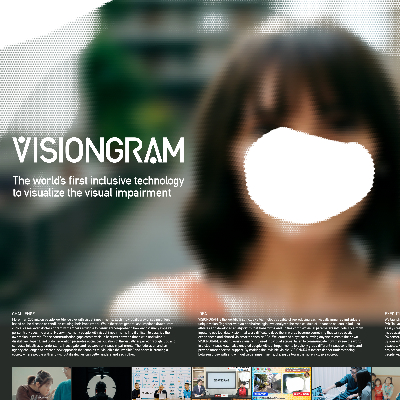
VISIONGRAM is the world’s first inclusive technology capable of reproducing each visually impaired individual’s unique vision. Based on personal eye test data, it generates visual filters that reproduces one’s vision in dots, simulating how they see and perceive the world. By simply inputting eye test data they already have, vision that were difficult to describe in words become something that can be easily experienced and shared via smartphones or PCs. We launched a system allowing anyone to create their own VISIONGRAM, enabling every visually impaired individual across Japan to communicate how they see the world in a clear, visual way. It also enabled people without impairments to quickly grasp different visual conditions and provide more effective support. By making the invisible visible, VISIONGRAM fosters deeper understanding between those with and without visual impairments, driving us toward a more inclusive society.
Insights & Strategy
We analyzed the medical data of Japanese national blind judo athletes, who have large amounts of eye test information. Together with an ophthalmologist who has a license of National Classifier of VI Athletes at International Blind Sports Federation, we developed a unique algorithm that transforms vision into dots, presenting complex and diverse factors (visual acuity, visual field, sensitivity, color deficiencies, etc.) in a unified and intuitive way. For instance, the fewer dots there are, the lower the visual acuity; the lower the dot density, the narrower the visual field; the smaller the dots, the poorer the sensitivity; and the dot’s color changes according to color deficiency. By inputting test data, the system enables to generate a camera filter that reproduces how each visually impaired individual sees, a perspective that was previously unknowable, in a way that can be grasped at a glance.
Execution
We launched VISIONGRAM as an official tool of the Japanese national blind judo team at the IBSA Judo Grand Prix Tokyo 2023, a world championship of blind judo held in Tokyo. During the event, athletes used VISIONGRAM to communicate their own vision on social media and other communication channels, sparking widespread attention. Soon after, a system that allows anyone to easily create their own VISIONGRAM by simply entering their own examination data of visual impairment was made available to the public. The visual filter generated by the system can be experienced with a smartphone or PC camera and can be shared through QR codes or links. After the public launch, the system was introduced not only by individual visually impaired people, but also by hospitals, university medical faculties, schools for the visually impaired, and support groups for the disabled throughout Japan.
Results
VISIONGRAM has been adopted by over 60 institutions across various industries. In hospitals, doctors use it during consultations to describe current visual conditions to patients and their families. At blind schools, teachers can understand each student’s individual vision, thereby improving the quality of education. It also assists in employment support initiatives between companies and people with visual impairments. As the world’s first initiative to visualize visual impairment, VISIONGRAM gained national attention in Japan, with numerous positive responses shared on social media by visually impaired users. One particular tweet reached 800,000 people. It was also featured on the front page of Japan’s oldest braille newspaper and in the Paralympic section of one of the country’s largest newspapers, recording more than 11 million reach. The project continues to grow nationwide, serving as inclusive technology that fosters mutual understanding between people with and without visual disabilities.
2025 Awards
Total Points: 3
Merit Honor

Credits
Agency
Dentsu Inc. / Tokyo
Production Company
PYRAMID FILM QUADRA INC. / Tokyo
SHINDII, LLC. / Kanagawa
Art Director
Seri Tanaka
Creative Director
Kazuhiro Shimura
Designer
Ryosuke Kon
Teppei Ichihara
Film Director
Tomoyuki Kato
Photographer
Hirohito Hiraga
Strategist
Kenta Oda
Engineer
Ayano Takahashi
Yasutaka Kurihara
Film producer
Takafumi Shindo
Inclusive Supervisor
Yusuke Hatsuse
Medical Supervisor (Ophthalmologist)
Takuya Tsuji
Planner
Ryo Seki
Tadahiko Maruyama
Tatsuya Abe
Related Awards