ADC Awards
ADC Annual Awards is the oldest continuously running industry award show in the world, with an incredible legacy of over 100 years. These awards celebrate the very best in advertising, digital media, graphic and publication design, packaging and product design, motion, experiential and spatial design, photography, illustration and fashion design – all with a focus on artistry and craftsmanship.
Background
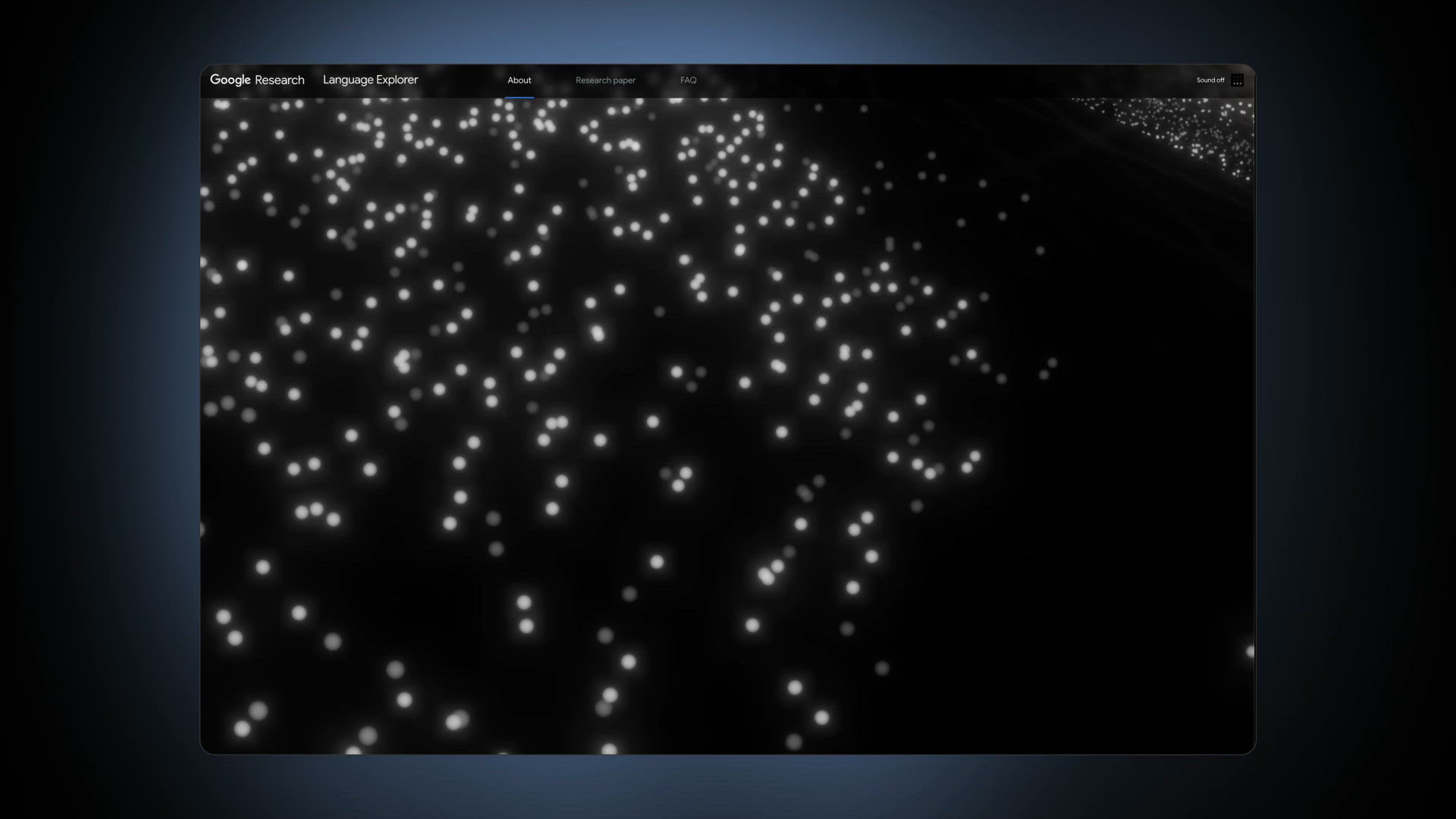
Over 7,000 languages are spoken worldwide, but less than 2% of them are well-represented online. This leaves millions of people without equal access. Google Research is trying to change that by making the world's information more accessible to everyone, one language at a time. The Language Inclusion Initiative began with an open-source data repository called LinguaMeta, developed from language samples that have been collected from native speakers across the globe. Until now, that data has lived exclusively on GitHub. We had to make it more usable for both researchers and the general population. Because most of the information available on linguistic diversity had previously been scattered across the internet or paywalled entirely, most people—even if they are curious about languages—know very little on the subject. It became clear that this work had to be visualized in an engaging way. The Language Explorer was created for anyone to interact with this data directly, regardless of their background.
Creative Idea
One question guided our process: How do you represent every spoken language on earth? It was essential that every region, language, and dialect was displayed accurately and equally, despite vast differences in the available data. The corresponding challenge was figuring out how to translate an existing GitHub page into an inspiring website that drives users to keep exploring. While linguists and language researchers are another key part of the audience, the site still had to feel relevant and functional for anyone curious about any language. We developed a navigation system around one unifying symbol—the globe. The Language Explorer site was built around a 3D globe, allowing users to follow their curiosity through exploring this responsive data visualizer.
Insights & Strategy
The linguistic field is dense with information, but communication and cultural curiosity are universal. The objective of the Google Language Explorer was to create an easy and visually appealing way to navigate the world’s largest open-source repository of language data, no matter the user. The site had to be easily accessible for researchers, as well as language enthusiasts and the general public. We began developing the navigation system around our top use cases. The search bar would be easily accessible for anyone who already knows what they're looking for. The complex filtration system can break data down by writing system, current number of speakers, and endangerment status. We held onto our goal of enabling users to explore their curiosity about the world’s languages simply by scrolling around the earth itself. The initial vision of the site required significant up-front dedication to deep research, specifically on how to best represent each language. We also ran into challenges with the site's UX structure early on, experimenting with a variety of approaches. After encountering these restrictions, we pivoted to a custom 3D globe and search filters. In the first stages of this Language Inclusion initiative, a team of researchers and photographers began visiting these communities to document the process of this work and the people directly impacted by its progress. This project had to reflect their needs when it came to language representation. We wanted to present a holistic view of every language, even if their respective datasets were inconsistently populated. The solutions we found in the end made each language page even more adaptive and accessible, achieving near-perfect Lighthouse accessibility scores across the board and making the content more accessible to a global audience.
Execution
The Google Language Explorer began its initial development stages in December 2024, and took nearly a year to complete. The site itself is built around a high-performance WebGL globe from scratch using Three.js with custom shaders. Standard HTML/CSS/JavaScript was used for all UI components. We initially experimented with prebuilt globe libraries, but quickly bumped into performance limitations and restrictions with design customization. We pivoted to a custom globe build, which allowed us the flexibility to better align with the creative vision, and deliver a site that is both performant and accessible. We also used the Web Audio API for adding dynamic reverb to all sound effects on the site. The website itself was managed in Root CMS and generated using Root.js, which intelligently collects only the custom elements used individually within each route, and bundles them accordingly in order to minimize the payload size. The entire experience is supported by a custom backend data pipeline. This pipeline refines and aggregates information from various sources, serving optimized data directly to the front-end. It also pre-generates key assets, such as the geometric shapes of countries, ensuring the overall user experience remains as smooth as possible. Until now, the LinguaMeta repository has only been available in its original format, leaving the data unoptimized and inaccessible to the majority of the population. After experimenting with a variety of options and approaches, we ended up customizing the back-end data pipeline so that the information is optimized before it even reaches the user. This way, the site experience remains consistent no matter which piece of data someone is looking at.
Results
The Google Language Explorer remains the most comprehensive source of language data available online, where users can discover information through maps, search, and detailed data pages on each of the world's 7000+ languages. This continues to be a free resource for all researchers and developers aiming to improve language accessibility, and has led to a range of app launches and global localization improvements. The data remains central to Google’s work in expanding language support and inclusivity across its products, impacting billions of people daily. Most recently, the initiative has led to the addition of 110 new languages in Google Translate—the largest expansion to date—providing translation access to 614 million speakers. As this work is applied to new tools and technologies, the internet’s information becomes more and more accessible for everyone.
2026 Awards
Total Points: 9

Bronze Cube

Credits
Agency
Hook / Ann Arbor
Client / Brand
Google / Mountain View
Production Company
Hook / Ann Arbor
Blinkk / San Francisco
Related Awards