The One Show
The One Show is the world's most prestigious award show in advertising and design. For over 50 years, the Gold Pencil has been regarded as one of the top prizes in the creative industry. The One Show has a rich legacy of honoring some of the most groundbreaking ideas, created by some of the most remarkable minds in creativity.
IDENTITY BUILDER
Agency Area 23, an IPG Health Company / New York + StudioRx, an IPG Health Company / New York + Black Madre / Sao Paulo + Shanghai Wanlong Cultural Communication Company / Guangzhong
Category
Online & Mobile
Annual ID
OS25_HW053M
Background
There are thousands of rare diseases, many so rare that patients are bound never to meet someone else with their condition. Unlike common conditions, 50% of rare diseases don’t have a support network or advocacy group. So, in addition to being sick, rare disease patients often feel alone and know nothing about their condition. On top of that, people with rare diseases that have no treatment find themselves having to be medical detectives, researching online and traveling to conferences to find clues and connections between their disease and others which do have a treatment.
With the Identity Builder, the goal of Zhejiang University was to 1) promote their advanced data science being conducted at their medical school, to differentiate themselves from other competing universities and 2) launch a tool that expresses the core tenet of their scientific research, that they have discovered myriad statistical connections among thousands of rare diseases.
With the Identity Builder, the goal of Zhejiang University was to 1) promote their advanced data science being conducted at their medical school, to differentiate themselves from other competing universities and 2) launch a tool that expresses the core tenet of their scientific research, that they have discovered myriad statistical connections among thousands of rare diseases.
Creative Idea
The Identity Builder is a procedural art generator that turns proprietary data about rare diseases into visual identities that allow patients with rare diseases to be seen and find connections between their disease and many others.
Each logo generated serves as a visualization and mnemonic device of important scientific information about the disease, that empowers patients and families who are still desperately searching for a treatment.
But beyond dynamically creating visual identities, this data-driven tool helps foster a deeper understanding of rare diseases among the general public and helps rare disease patients build communities with others who are undergoing a similar experience.
Each logo generated serves as a visualization and mnemonic device of important scientific information about the disease, that empowers patients and families who are still desperately searching for a treatment.
But beyond dynamically creating visual identities, this data-driven tool helps foster a deeper understanding of rare diseases among the general public and helps rare disease patients build communities with others who are undergoing a similar experience.
Insights & Strategy
There are more than 20 million rare disease patients in China, with 200,000 new patients diagnosed yearly. Despite these numbers, a rare disease patient still feels alone, especially in China, where decades of the 1-child policy left unintended consequences. For the Chinese, having a rare disease can be a sign that you are defective and a source of shame for patients and families. It’s the curse of being rare.
The result is that these diseases are not seen as legitimate and established diseases, and patients end up not having community support to overcome the stigma.
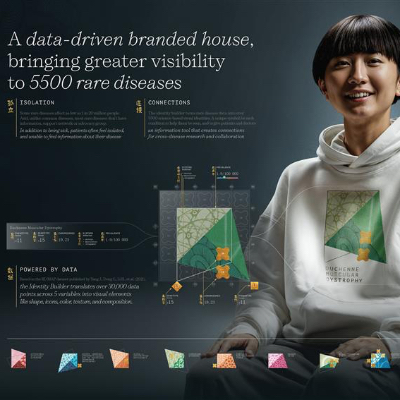
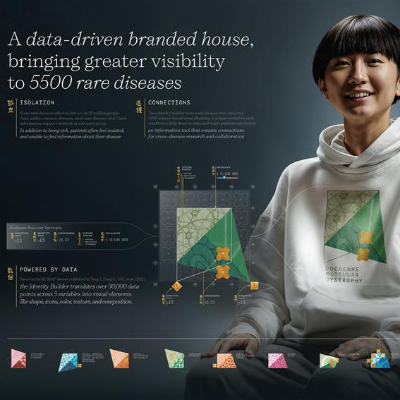
Working with Zhejiang University, we decided to change that. Based on their Rare Disease MAP (RDMAP) statistical database, we created a procedural art generator that turns scientific data about 5500 rare diseases into unique visual identities for each. Now, patients who once felt ashamed, invisible, and illegitimate, can finally have a unique symbol to help them feel seen and to empower them with new and helpful scientific knowledge about their disease.
The result is that these diseases are not seen as legitimate and established diseases, and patients end up not having community support to overcome the stigma.
Working with Zhejiang University, we decided to change that. Based on their Rare Disease MAP (RDMAP) statistical database, we created a procedural art generator that turns scientific data about 5500 rare diseases into unique visual identities for each. Now, patients who once felt ashamed, invisible, and illegitimate, can finally have a unique symbol to help them feel seen and to empower them with new and helpful scientific knowledge about their disease.
Execution
We translated the Rare Disease Map study (http://rdmap.nbscn.org/) into 5 relevant data variables. Then, we built our prototype procedural art generator that processes these 5 variables across 5500 constants. Next, we created a design system around these variables, which we incorporated into a digital tool, UX, and accompanying UI. The final element was to develop a “connections” feature that allows users to match their disease and explore similarities between their condition and others.
We launched the Identity Builder in China on Rare Disease Day, amplifying our reach across disease groups through the Chinese Association of Rare Diseases (CHARD) and using the research network of Zhejiang University to reach all medical schools in China in a live conference in Shanghai.
Now, rare disease patients who feel invisible have a unique symbol to help them be seen and a powerful data visualization tool to help them find a cure.
We launched the Identity Builder in China on Rare Disease Day, amplifying our reach across disease groups through the Chinese Association of Rare Diseases (CHARD) and using the research network of Zhejiang University to reach all medical schools in China in a live conference in Shanghai.
Now, rare disease patients who feel invisible have a unique symbol to help them be seen and a powerful data visualization tool to help them find a cure.
Results
Rare disease patients who had never seen or met someone else with a similar condition have started to create connections using the Identity Builder.
Of the rare disease organizations that received the Identity Builder through CHARD, 80% of them promoted the project to their constituents, resulting in over 300,000 individual searches and over 50k downloads in 1 month after Rare Disease Day.
Social posts on WeChat about the campaign were 100% of positive sentiment.
An attitudinal study among researchers and medical students fielded after the campaign launched ranked Zhejiang University as #2 in innovation among all medical schools in China, up from #5 year-over-year The school ranked #1 in rare disease research, up from #2 YOY.
“I’ve never thought that other people with rare diseases like me had so many things in common.” Dong Chengcheng
Of the rare disease organizations that received the Identity Builder through CHARD, 80% of them promoted the project to their constituents, resulting in over 300,000 individual searches and over 50k downloads in 1 month after Rare Disease Day.
Social posts on WeChat about the campaign were 100% of positive sentiment.
An attitudinal study among researchers and medical students fielded after the campaign launched ranked Zhejiang University as #2 in innovation among all medical schools in China, up from #5 year-over-year The school ranked #1 in rare disease research, up from #2 YOY.
“I’ve never thought that other people with rare diseases like me had so many things in common.” Dong Chengcheng
2025 Awards
Total Points: 3

Merit
Credits
Agency
Area 23, an IPG Health Company / New York
Design Firm
Black Madre / São Paulo
Client / Brand
Zhejiang University / Hangzhou
Agency In-House Production Company
Studio Rx, an IPG Health Company / New York
Production Company
Shanghai Wanlong Cultural Communication Company / Guangzhong
Associate Creative Director
Lily Liu
Matthew Sherring
Renan Bulgari
Diana Yeo
Justin Schlaffer
Chief Creative Officer
Tim Hawkey
Creative Director
Diego Tórgo
Sttenio Costa
Victor Afonso
Andre Maciel
Executive Creative Director
Josh Grossberg
Group Creative Director
Felipe Munhoz
Illustrator
Leandro Dexter
Product Designer
Cliff Washington
Liz Culton
Executive Producer
Tom Sann
Chinkara Singh
Associate Director, Animation
Christopher Romano
Creative Engineering Director
Aaron Stack
Director Experience Design
Mario Arias
Executive Director
Tina Castro
Executive Director Experience Design
Franklin Williams
Executive Director, Medical Strategy
Mike Lieberman
Head of Planning
Le Alves
Head of Production
Laryssa Andrade
Production
Icaro Yuji
Senior Video Editor
Megan Katuran
Technology Director
Bill Hanff
VP, Director Video Post-Production
Conor OFlynn
Related Awards