The One Show
The One Show is the world's most prestigious award show in advertising and design. For over 50 years, the Gold Pencil has been regarded as one of the top prizes in the creative industry. The One Show has a rich legacy of honoring some of the most groundbreaking ideas, created by some of the most remarkable minds in creativity.
Learn more about The One Show 2026
You have exceeded your allotted number of views.
For full access to our extensive awards archive
Members Login Here
For full access to our extensive awards archive
Members Login Here
Category
Use of Technology / AI
Annual ID
OS25_MI125M
Background
We needed to strengthen brand equity and celebrate 20 years of Dove's Real Beauty — not only to reaffirm its relevance but also to reimagine its impact in a new era.
Over the years, Real Beauty has evolved from an advertising concept to a brand commitment: making beauty a source of happiness for all women, not anxiety. However, 20 years later, many brands have embraced similar messages of self-esteem and acceptance. And while this has positively contributed to collective awareness, it has also created a crowded space.
For Dove, the mission was clear: reaffirm its relevance and reimagine Real Beauty's impact for future generations.
Though 20 years have passed since the Real Beauty Campaign launched, the problem persists - especially with the rise of social media and emerging technologies. By reaffirming its leadership in challenging beauty standards, Dove seized the opportunity to redefine Real Beauty's role in a new era of beauty confidence.
While social media connects women with beauty content, it also exacerbates pressure and self-image anxiety. A significant number of young women report dissatisfaction with their bodies, with 1 in 3 feeling compelled to change their appearance due to unrealistic beauty standards online.
To make matters worse, by 2025 it's estimated that 90% of online content will be generated by Artificial Intelligence. In just the past year, over 15 million images were created using text-to-image algorithms. AI often depicts women with unrealistic bodies - no fat, no blemishes, and typically young, light-skinned, with blue or green eyes. Specialists explain that AI replicates societal beauty biases through machine learning. But what if these machines reflected Dove's Real Beauty imagery instead? That's the question that led us to our big idea.
Over the years, Real Beauty has evolved from an advertising concept to a brand commitment: making beauty a source of happiness for all women, not anxiety. However, 20 years later, many brands have embraced similar messages of self-esteem and acceptance. And while this has positively contributed to collective awareness, it has also created a crowded space.
For Dove, the mission was clear: reaffirm its relevance and reimagine Real Beauty's impact for future generations.
Though 20 years have passed since the Real Beauty Campaign launched, the problem persists - especially with the rise of social media and emerging technologies. By reaffirming its leadership in challenging beauty standards, Dove seized the opportunity to redefine Real Beauty's role in a new era of beauty confidence.
While social media connects women with beauty content, it also exacerbates pressure and self-image anxiety. A significant number of young women report dissatisfaction with their bodies, with 1 in 3 feeling compelled to change their appearance due to unrealistic beauty standards online.
To make matters worse, by 2025 it's estimated that 90% of online content will be generated by Artificial Intelligence. In just the past year, over 15 million images were created using text-to-image algorithms. AI often depicts women with unrealistic bodies - no fat, no blemishes, and typically young, light-skinned, with blue or green eyes. Specialists explain that AI replicates societal beauty biases through machine learning. But what if these machines reflected Dove's Real Beauty imagery instead? That's the question that led us to our big idea.
Creative Idea
A campaign that subverted AI’s logic with a simple adjustment to the prompts used in generative tools: we discovered that by adding "according to Dove's Real Beauty Campaign," we could yield more diverse representations—showing women of different races, ethnicities, body types, and hair textures, all reflecting Dove’s values over the past 20 years.
Conventional AI image generators often produce narrow, standardized ideals of beauty when prompted with terms like "a beautiful woman" or "a confident woman."
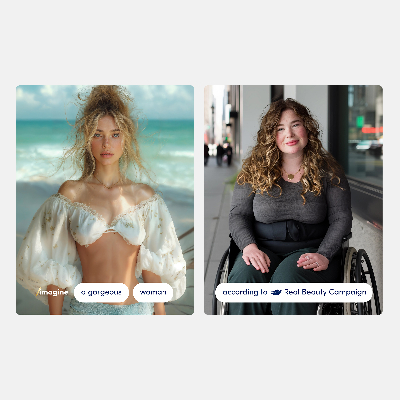
Using Midjourney, Dove tested this influence with direct prompts. For example, when asked to “imagine a beautiful woman,” the AI generated images of young, thin, white women with flawless skin and light hair, posing like models. However, when the prompt was changed to “imagine a beautiful woman according to Dove’s Real Beauty Campaign,” the results were markedly different: a woman with darker skin, curly hair, and a smile. Similarly, when prompted to “imagine a CEO,” the AI initially generated an image of a white man in a suit, seated at a desk. But when altered to “imagine a CEO according to Dove’s Real Beauty Campaign,” the AI generated images of women from various races, all smiling.
This test was also conducted with other brands in the same sector, whose prompts often led to less diverse images. This underscored that only Dove, with 20 years of work, had truly influenced AI’s coding to reflect a more inclusive beauty standard.
To conduct the test, we used Midjourney V6 with private accounts, configuring settings to RAW Mode, s250, and highly stylized. OpenAI data was used to generate images authentically created by AI tools. All images were audited by Unilever’s Legal Team to ensure accuracy. These images were directly inspired by Dove’s historical data, now interpreted by machines.
Conventional AI image generators often produce narrow, standardized ideals of beauty when prompted with terms like "a beautiful woman" or "a confident woman."
Using Midjourney, Dove tested this influence with direct prompts. For example, when asked to “imagine a beautiful woman,” the AI generated images of young, thin, white women with flawless skin and light hair, posing like models. However, when the prompt was changed to “imagine a beautiful woman according to Dove’s Real Beauty Campaign,” the results were markedly different: a woman with darker skin, curly hair, and a smile. Similarly, when prompted to “imagine a CEO,” the AI initially generated an image of a white man in a suit, seated at a desk. But when altered to “imagine a CEO according to Dove’s Real Beauty Campaign,” the AI generated images of women from various races, all smiling.
This test was also conducted with other brands in the same sector, whose prompts often led to less diverse images. This underscored that only Dove, with 20 years of work, had truly influenced AI’s coding to reflect a more inclusive beauty standard.
To conduct the test, we used Midjourney V6 with private accounts, configuring settings to RAW Mode, s250, and highly stylized. OpenAI data was used to generate images authentically created by AI tools. All images were audited by Unilever’s Legal Team to ensure accuracy. These images were directly inspired by Dove’s historical data, now interpreted by machines.
Insights & Strategy
Although AI, at the time of Dove's campaign launch, portrayed women in a stereotypical manner online, it is not the villain.
AI operates on machine learning technology, which means it mirrors societal beauty stereotypes. But what if these machines reflected Dove's Real Beauty imagery instead?
With over 2,800 global campaigns featuring more than 14,000 real women from diverse backgrounds, body shapes, skin tones, and ages, Dove has consistently showcased real beauty. But could this consistency actually influence artificial intelligence?
Using Midjourney, we conducted a test. The prompt “imagine a beautiful woman” generated images of white, thin, young women with light skin and hair, posed like models. However, when we modified the prompt to “imagine a beautiful woman according to Dove’s Real Beauty Campaign,” the result shifted: the AI generated an image of a woman with darker skin, curly hair and a smile.
As Dove celebrates 20 years of advocating for Real Beauty, the rise of AI-generated imagery presented both a challenge and an opportunity. It was the chance to influence AI to reflect Dove’s inclusive standards while reinforcing its pioneering role in promoting authentic beauty. In a landscape where many brands have adopted messages of diversity and inclusion, Dove leads the way in advancing these ideals within the digital realm.
By successfully embedding Dove’s Real Beauty ethos into AI’s framework, the Dove Code reestablishes Dove as a leader in reshaping beauty standards and inspiring confidence in women - especially as digital influence continues to grow.
AI operates on machine learning technology, which means it mirrors societal beauty stereotypes. But what if these machines reflected Dove's Real Beauty imagery instead?
With over 2,800 global campaigns featuring more than 14,000 real women from diverse backgrounds, body shapes, skin tones, and ages, Dove has consistently showcased real beauty. But could this consistency actually influence artificial intelligence?
Using Midjourney, we conducted a test. The prompt “imagine a beautiful woman” generated images of white, thin, young women with light skin and hair, posed like models. However, when we modified the prompt to “imagine a beautiful woman according to Dove’s Real Beauty Campaign,” the result shifted: the AI generated an image of a woman with darker skin, curly hair and a smile.
As Dove celebrates 20 years of advocating for Real Beauty, the rise of AI-generated imagery presented both a challenge and an opportunity. It was the chance to influence AI to reflect Dove’s inclusive standards while reinforcing its pioneering role in promoting authentic beauty. In a landscape where many brands have adopted messages of diversity and inclusion, Dove leads the way in advancing these ideals within the digital realm.
By successfully embedding Dove’s Real Beauty ethos into AI’s framework, the Dove Code reestablishes Dove as a leader in reshaping beauty standards and inspiring confidence in women - especially as digital influence continues to grow.
Execution
The campaign was executed in three primary stages:
Global Launch and Awareness: Dove organized simultaneous launch events in New York and London, attended by activists against AI gender bias, influencers, and the press. At these events, Dove presented findings from its global study, "The New Global State of Beauty," which highlighted AI’s impact on women’s self-perception. The events featured a live demonstration showcasing how Dove's prompts generated more diverse representations compared to generic AI inputs. Dove also provided a free guide on using AI more inclusively.
Commitment and Amplification: Dove released a global 120-second film, “The Dove Code,” illustrating how Dove’s consistency has influenced AI’s concept of beauty. The film emphasized Dove’s commitment to never use AI to create or replace real women in its campaigns. The campaign reached 30 countries in Q2 2024, with various films (120”, 60”, 15”) featuring the iconic song “Pure Imagination” performed by Victoria Canal, an emerging artist and advocate for diversity and inclusion.
Engagement on Media and Social Networks: Through print, OOH, and social media, Dove showcased AI-generated images created using the Dove Code. Examples included contrast such as “imagine a confident Brazilian woman” versus “imagine a confident Brazilian woman according to Dove’s Real Beauty Campaign.” This sparkled public engagement and conversation, emphasizing the need for positive, inclusive examples to help AI recognize and reflect real beauty.
Global Launch and Awareness: Dove organized simultaneous launch events in New York and London, attended by activists against AI gender bias, influencers, and the press. At these events, Dove presented findings from its global study, "The New Global State of Beauty," which highlighted AI’s impact on women’s self-perception. The events featured a live demonstration showcasing how Dove's prompts generated more diverse representations compared to generic AI inputs. Dove also provided a free guide on using AI more inclusively.
Commitment and Amplification: Dove released a global 120-second film, “The Dove Code,” illustrating how Dove’s consistency has influenced AI’s concept of beauty. The film emphasized Dove’s commitment to never use AI to create or replace real women in its campaigns. The campaign reached 30 countries in Q2 2024, with various films (120”, 60”, 15”) featuring the iconic song “Pure Imagination” performed by Victoria Canal, an emerging artist and advocate for diversity and inclusion.
Engagement on Media and Social Networks: Through print, OOH, and social media, Dove showcased AI-generated images created using the Dove Code. Examples included contrast such as “imagine a confident Brazilian woman” versus “imagine a confident Brazilian woman according to Dove’s Real Beauty Campaign.” This sparkled public engagement and conversation, emphasizing the need for positive, inclusive examples to help AI recognize and reflect real beauty.
Results
The campaign film achieved over 500 million organic views worldwide, generating 4 billion organic impressions. The conversation sparked by Dove attracted massive media attention, resulting in over 1,000 global press and social media publications. This marked the largest PR coverage in the brand's history, and despite the high visibility, the campaign maintained a positive sentiment score of 94%.
The campaign was globally evaluated using the System 1 methodology, demonstrating its ability to connect impact with business by boosting purchase intent. It received a rating of 4.6 stars, making it the highest-rated ad in its category.
Generative AI platforms also made significant strides toward inclusivity. Adobe’s Firefly, the leading AI creative content generation platform for safe commercial use, presented at the 2024 Embedded Vision Summit—a three-day event where tech professionals discuss the latest in AI. Adobe introduced the “Harm and Bias Evaluation and Solution,” an initiative design to combat previous biases by producing more diverse and realistic representations, helping to foster fairer standards within digital image generation
For more details, see the Embedded Vision Summit presentation - https://www.edge-ai-vision.com/2024/09/harm-and-bias-evaluation-and-solution-for-adobe-firefly-a-presentation-from-adobe/
The campaign was globally evaluated using the System 1 methodology, demonstrating its ability to connect impact with business by boosting purchase intent. It received a rating of 4.6 stars, making it the highest-rated ad in its category.
Generative AI platforms also made significant strides toward inclusivity. Adobe’s Firefly, the leading AI creative content generation platform for safe commercial use, presented at the 2024 Embedded Vision Summit—a three-day event where tech professionals discuss the latest in AI. Adobe introduced the “Harm and Bias Evaluation and Solution,” an initiative design to combat previous biases by producing more diverse and realistic representations, helping to foster fairer standards within digital image generation
For more details, see the Embedded Vision Summit presentation - https://www.edge-ai-vision.com/2024/09/harm-and-bias-evaluation-and-solution-for-adobe-firefly-a-presentation-from-adobe/
2025 Awards
Total Points: 3

Merit

Credits
Agency
Droga5 / São Paulo
Client / Brand
Unilever - Dove / São Paulo
Production Company
Saigon / Sao Paulo
The Mill / New Yok
Estúdio DiProd / Florianópolis
Music / Sound Production Company
Big Sync Music / SÃO PAULO
Hefty / São Paulo
Art Director
Eduardo Diniz
Heloisa Lima
Pedro Miranda
Chief Creative Officer
Rafael Ziggy
Chief Design Officer
Diego Limberti
Content Creator
Kelly Neres
Copywriter
Lucas Abreu
Vitoria Ferrari
Executive Creative Director
Marina Cota
Rafael Alves
Vinicius Chagas
Account Director
Renata Franceschi
Account Group Director
Juliana Pereira
Account Manager
Julia Andreucci
Mariana Mazzoli
Brand Strategy
Gabriella Brum
Broadcast Leader
Fabíola Ribeiro
Broadcast Senior
Bárbara Rafaelli
Renata Müller
CEO & Creative Chairperson
Felipe Simi
CMO Beauty & Wellbeing NY
Leandro Barreto
CMO Dove
Alessandro Manfredi
Co-CEO
Brisa Vicente
COO
Felipe Belinky
Creative Leader
Juliana Jabra
Nayara Lima
Data Group Director
Matheus Facci
Data Strategy
Rany Higa
Dove Global Brand Director Masterbrand & Strategy
Pau Bartoli
Global Brand Manager Dove Masterbrand
Victoria Floyd
Global Marketing Dove Masterbrand
Stella Megalou
Head of Account Management
Verena Neves
Head of Broadcasting
Fabiane Abel
Head of Operations and Production
Lucas Cardoso
Head of Strategy & Data
Mariana Cordeiro
Project Leader
Tatiane Donatangelo
Project Manager
Pamela Santos
Rafael Messias
Strategy Group Director
Keid Sammour
Vice-President - Dove Masterbrand Global & North America
Firdaous El Honsali
VP of Account Management
Renata Cintra
VP of Brand & Connections Strategy
Ana Cortat
VP of Impact
Gabriela Rodrigues
VP of Operations and Production
Larissa Kubo
Related Awards