The One Show
The One Show is the world's most prestigious award show in advertising and design. For over 50 years, the Gold Pencil has been regarded as one of the top prizes in the creative industry. The One Show has a rich legacy of honoring some of the most groundbreaking ideas, created by some of the most remarkable minds in creativity.
You have exceeded your allotted number of views.
For full access to our extensive awards archive
Members Login Here
For full access to our extensive awards archive
Members Login Here
Category
Sustainable Development Goals
Annual ID
OS25_SD007M
Background
In the world, there are thousands of abandoned places that don't even appear on Google.
Communities that remain invisible. In Mexico, more than 47 million people don’t have a home, let alone an address. They lack basic services and are not recognized by the government.
In this context, Techo, an NGO that builds houses for the people that live at informal settlements, needed to help make these communities visible. And we did that by addressing the problem and by, literally, giving them an address using Google technology.
Situation: In Mexico, more than 47 million people don’t have a home, let alone an address. They lack basic services and are not recognized by the government.
Brief: How to help make these communities visible, aligned to the UN’s goals?
Objectives: To give marginalized people an address to start getting their official ID’s, receive mail, and even call for an ambulance. This way, they could get recognition from the government to plan ahead for basic services like potable water, electricity, and paving.
Communities that remain invisible. In Mexico, more than 47 million people don’t have a home, let alone an address. They lack basic services and are not recognized by the government.
In this context, Techo, an NGO that builds houses for the people that live at informal settlements, needed to help make these communities visible. And we did that by addressing the problem and by, literally, giving them an address using Google technology.
Situation: In Mexico, more than 47 million people don’t have a home, let alone an address. They lack basic services and are not recognized by the government.
Brief: How to help make these communities visible, aligned to the UN’s goals?
Objectives: To give marginalized people an address to start getting their official ID’s, receive mail, and even call for an ambulance. This way, they could get recognition from the government to plan ahead for basic services like potable water, electricity, and paving.
Creative Idea
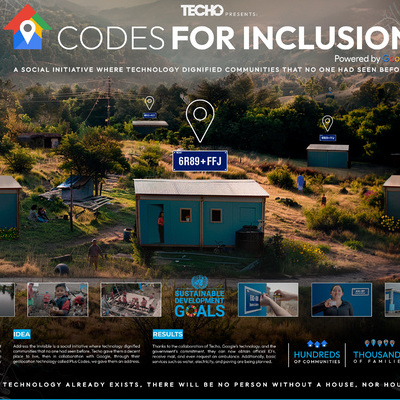
TECHO presents: Codes for Inclusion, a social initiative where technology dignified communities that no one had seen before. Techo gave them a decent place to live.Then in
collaboration with Google, through their geolocation technology called Plus Codes, we gave them an address.
collaboration with Google, through their geolocation technology called Plus Codes, we gave them an address.
Insights & Strategy
"There should not be a person without a home, nor a home without an address" - the insight that inspired the strategic development.
It all began with Techo's mission, and while with each development they bring life to its essence and deliver housing that promotes a more dignified life, an opportunity was detected to enhance the positive impact they generate in each of the communities they support.
It was from that point that there was an effort to develop a partnership with Google, the largest technology company in the world, to leverage one of its most interesting tools: Plus Codes, a technology that has the potential to place these communities on the map, giving it a use that had never seen before.
It all began with Techo's mission, and while with each development they bring life to its essence and deliver housing that promotes a more dignified life, an opportunity was detected to enhance the positive impact they generate in each of the communities they support.
It was from that point that there was an effort to develop a partnership with Google, the largest technology company in the world, to leverage one of its most interesting tools: Plus Codes, a technology that has the potential to place these communities on the map, giving it a use that had never seen before.
Execution
First, Techo gave people in informal settlements a decent place to live. Then in collaboration with Google, through the use of their geolocation technology called Plus Codes, we gave them an address.
Plus Codes are alphanumeric codes that take into consideration latitude and longitude. It's totally free and open source and works as a substitute for an address.
With the initiative in course, the communities, word of mouth, the subsequent ability of the settlers to started getting their official ID’s, receive mail and even call for an ambulance as a result of having a digital address, the attention of the authorities was caught.
And then, local governments pledged to plan ahead for basic services like potable water, electricity and paving.
Plus Codes are alphanumeric codes that take into consideration latitude and longitude. It's totally free and open source and works as a substitute for an address.
With the initiative in course, the communities, word of mouth, the subsequent ability of the settlers to started getting their official ID’s, receive mail and even call for an ambulance as a result of having a digital address, the attention of the authorities was caught.
And then, local governments pledged to plan ahead for basic services like potable water, electricity and paving.
Results
Codes for Inclusion is not a regular advertising campaign. Consequently, results and metrics cannot be measured traditionally. However, the deep social impact and the success of the initiative is evident:
The support of government leaders like the Mayor of the Ixtapaluca Municipality in the State of Mexico allowed people to change their attitude towards communities that were otherwise invisible. Now Mexicans see Techo not only as builders of decent homes for the outcast, but as allies to help them claim a dignified living with basic services.
More than 50 media outputs, both local and international, covered the initiative.
Techo builds more than 7 thousand houses in Latin America per year, with only one year of deploying this initiative in Mexico we reached hundreds of communities (153) and thousands of families (2156), and now that the initiative it’s a standard practice of training between Google engineers and Techo Volunteers in Mexico only. This initiative projects a SCALABILITY to reach more than 300 million in 5 years through all of Latin America and the world.
And even when geolocation technology already exists, our initiative will leave no person without a house, nor a house without an address.
The support of government leaders like the Mayor of the Ixtapaluca Municipality in the State of Mexico allowed people to change their attitude towards communities that were otherwise invisible. Now Mexicans see Techo not only as builders of decent homes for the outcast, but as allies to help them claim a dignified living with basic services.
More than 50 media outputs, both local and international, covered the initiative.
Techo builds more than 7 thousand houses in Latin America per year, with only one year of deploying this initiative in Mexico we reached hundreds of communities (153) and thousands of families (2156), and now that the initiative it’s a standard practice of training between Google engineers and Techo Volunteers in Mexico only. This initiative projects a SCALABILITY to reach more than 300 million in 5 years through all of Latin America and the world.
And even when geolocation technology already exists, our initiative will leave no person without a house, nor a house without an address.
2025 Awards
Total Points: 3

Merit

Credits
Agency
Archer Troy / Mexico City
Client / Brand
Google México / Mexico City
Techo México / Mexico City
Art Director
Cecilia Morales Vrátny
Denisse Reynoso
Chief Creative Officer
Mike Arciniega
Copywriter
Carlos Leyva
Haim Torres
Creative Director
Edgardo Gamboso
Leonardo Sánchez
Creative Technologist
Pablo Sotres
Executive Creative Director
Carlos Fernandez Oxte
Guillermo Bernal
Group Creative Director
Chaz Torres
Head of Art
Pedro Molina
Account Director
Nayeli Jessel
Thelma Arcinas
Communication & PR Director
Andrea Ramírez
Head of Creative Services
Benjamin Delvingt
Local Director
Fernando Durán
Frida Sernas
Sharonye De la rosa
Production
Emmanuel García
Fernando Cárdenas
Julio Ramírez
Vica Islas
Strategic Partnership Manager
Sebastian Hiernaux
Related Awards