The One Show
The One Show is the world's most prestigious award show in advertising and design. For over 50 years, the Gold Pencil has been regarded as one of the top prizes in the creative industry. The One Show has a rich legacy of honoring some of the most groundbreaking ideas, created by some of the most remarkable minds in creativity.
Category
New Media Innovation & Development / New Media Innovation and Development
URL
Click to launch
Annual ID
07239N
About the Work
Challenge
The Acura division of the American Honda Motor Company, as part of their continuing strategy to establish themselves as an innovative, technology-focused luxury brand, commissioned George P. Johnson to create a brand new exhibit for the 2007 auto show season that by its very nature says ìinnovation.î Central to the new exhibits would be a series of interactive installations, highlighted by the Interactive Oracles.
The intended consumer take away was for the user to see Acura as an innovator that is always looking to the future and integrating the latest cutting edge, customer-relevant technologies into their vehicles. The communication challenge the team faced was how to create an installation that is user-friendly and effectively communicates customer relevant stories that show how an Acura improves the usersí life.
While developing the Interactive Oracle concept, the team set out to achieve 3 specific goals. The first was to create a circular display system that could be approached from any angle and be used by multiple people at once. Second, the Oracles would also have to integrate a sensor system that would allow for people to use both of their hands at the same time. Further, the team would need to allow the display system to be completely self-contained so that is could easily be moved from one location to another. To accomplish these goals, George P. Johnson enlisted the services of MOTO Development Group to create the multi-user sensor system and Mindflood to create all of the interactive content and integrate it into a Flash user interface.
Solution
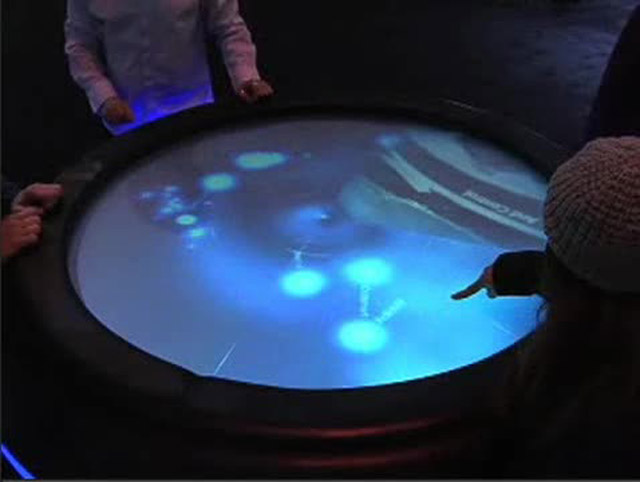
Each of the three Oracles consists of a tabletop based projection with a high lumen projector mounted underneath and a multi-user sensor system above. The Flash user interface allows for each Oracle to be approached from any angle as the tabletop is divided into four usable quadrants of message delivery. The content then automatically orients itself to the quadrant closest to the user. The entire Oracle surface is seamlessly connected so that each userís interaction causes it to react in a unique way. Multiple users can select individual particles as they float by and then activate them with their hands.
As Mindflood carefully developed the content, the overarching vision was for the Oracles to serve as an interface that acted as a pool of energy, containing orbs or thought particles that float within the energy field. Users can touch a thought particle, open it, experience it, release it and then open another. The nine technology stories that the content told were organized into three categories and were represented by spheres. Each story had its own unique personality and communicated how Acura technology either ìConnects You,î ìProtects Youî or ìEmpowers You.î The stories are not about how the technology technically functions but rather more about how it benefits the userís life.
Result
The Acura Interactive Oracles made their successful debut at the 2007 North American International Auto Show in Detroit, and left attendees who interacted with them thinking, ìI have never seen anything quite like that before.î The oracles combined a first of its kind multi-user environment along with strong visuals and motion graphics to tell compelling stories about how Acura technologies help make driving a more enjoyable experience. Attendees who were able to peer into and experience the Oracles, and what seemed like future technology, soon realized that Acura offers these life-enhancing technologies now and this was just one of the many reasons Acura vehicles allow their drivers to ìlive life in advanceî.
The Acura division of the American Honda Motor Company, as part of their continuing strategy to establish themselves as an innovative, technology-focused luxury brand, commissioned George P. Johnson to create a brand new exhibit for the 2007 auto show season that by its very nature says ìinnovation.î Central to the new exhibits would be a series of interactive installations, highlighted by the Interactive Oracles.
The intended consumer take away was for the user to see Acura as an innovator that is always looking to the future and integrating the latest cutting edge, customer-relevant technologies into their vehicles. The communication challenge the team faced was how to create an installation that is user-friendly and effectively communicates customer relevant stories that show how an Acura improves the usersí life.
While developing the Interactive Oracle concept, the team set out to achieve 3 specific goals. The first was to create a circular display system that could be approached from any angle and be used by multiple people at once. Second, the Oracles would also have to integrate a sensor system that would allow for people to use both of their hands at the same time. Further, the team would need to allow the display system to be completely self-contained so that is could easily be moved from one location to another. To accomplish these goals, George P. Johnson enlisted the services of MOTO Development Group to create the multi-user sensor system and Mindflood to create all of the interactive content and integrate it into a Flash user interface.
Solution
Each of the three Oracles consists of a tabletop based projection with a high lumen projector mounted underneath and a multi-user sensor system above. The Flash user interface allows for each Oracle to be approached from any angle as the tabletop is divided into four usable quadrants of message delivery. The content then automatically orients itself to the quadrant closest to the user. The entire Oracle surface is seamlessly connected so that each userís interaction causes it to react in a unique way. Multiple users can select individual particles as they float by and then activate them with their hands.
As Mindflood carefully developed the content, the overarching vision was for the Oracles to serve as an interface that acted as a pool of energy, containing orbs or thought particles that float within the energy field. Users can touch a thought particle, open it, experience it, release it and then open another. The nine technology stories that the content told were organized into three categories and were represented by spheres. Each story had its own unique personality and communicated how Acura technology either ìConnects You,î ìProtects Youî or ìEmpowers You.î The stories are not about how the technology technically functions but rather more about how it benefits the userís life.
Result
The Acura Interactive Oracles made their successful debut at the 2007 North American International Auto Show in Detroit, and left attendees who interacted with them thinking, ìI have never seen anything quite like that before.î The oracles combined a first of its kind multi-user environment along with strong visuals and motion graphics to tell compelling stories about how Acura technologies help make driving a more enjoyable experience. Attendees who were able to peer into and experience the Oracles, and what seemed like future technology, soon realized that Acura offers these life-enhancing technologies now and this was just one of the many reasons Acura vehicles allow their drivers to ìlive life in advanceî.
2007 Awards
Total Points: 5

Merit

Credits
Production Company
Mindflood
George P. Johnson
Art Director
Noah Costello
Group Creative Director
Geoff Mye
Chris Lund
Nikolai Cornell
Designer
Woo Sung Kim
Information Architect
Chris Kief
Programmer
Chris Kief
Writer
Geoff Mye
Content Strategist
Nikolai Cornell
Geoff Mye
Julien Le Bas
Noah Costello
Digital Artist / Multimedia
Sebastian Bettencourt
Related Awards