The One Show
The One Show is the world's most prestigious award show in advertising and design. For over 50 years, the Gold Pencil has been regarded as one of the top prizes in the creative industry. The One Show has a rich legacy of honoring some of the most groundbreaking ideas, created by some of the most remarkable minds in creativity.
Category
Sound Editing
Annual ID
OS26_MS032M
Background
Founded in 1989 as a crisis line, Kids Help Phone (KHP) has evolved into Canada’s only free, 24/7 e-mental health service dedicated to youth – funded largely through public donations. Yet its legacy as a crisis line continues to shape how help is understood – and whether adults recognize their role in supporting it financially.
Challenge
Many people still don’t understand what KHP does – because their name sounds like it’s only for emergencies(1).
As a result, adults underestimate the scope of KHP’s help and the need to fund it, even as demand for youth mental health services continues to grow(2).
Objective
To drive donations from adults by:
1. Clarifying KHP’s importance as support for everyday emotions – not just crisis
2. Reinforcing the urgency of supporting KHP financially.
Challenge
Many people still don’t understand what KHP does – because their name sounds like it’s only for emergencies(1).
As a result, adults underestimate the scope of KHP’s help and the need to fund it, even as demand for youth mental health services continues to grow(2).
Objective
To drive donations from adults by:
1. Clarifying KHP’s importance as support for everyday emotions – not just crisis
2. Reinforcing the urgency of supporting KHP financially.
Creative Idea
Help! shows that “help” from KHP means everything.
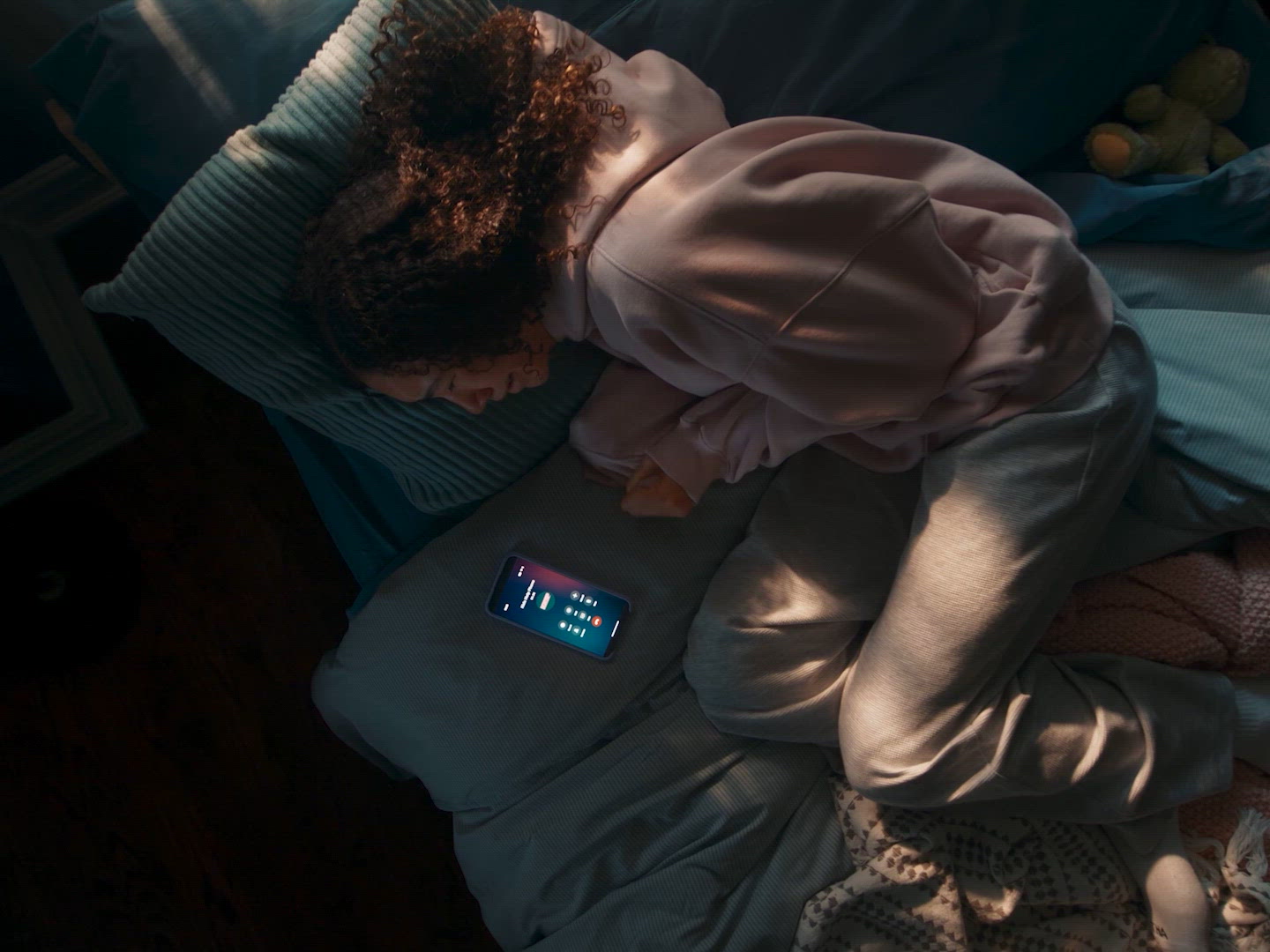
Drawn from over 50 million data points from anonymized and aggregated conversations with KHP, we transformed lived emotional experiences into the creative itself. By showing that help exists for all emotions, Help! makes youth mental health visible to adults – highlighting the need for support.
Drawn from over 50 million data points from anonymized and aggregated conversations with KHP, we transformed lived emotional experiences into the creative itself. By showing that help exists for all emotions, Help! makes youth mental health visible to adults – highlighting the need for support.
Insights & Strategy
94% of parents think their kids’ mental health is “good”(3), yet 1 in 2 young people report struggling with their mental health alone(4). This gap reveals a critical disconnect – not in need, but in adult understanding of when and how support is needed.
Social listening reinforces this tension. Young people express a desire for help but hesitate to involve adults, sharing sentiments like “I really want to tell my parents but I’m scared” and “how do I tell my parents?(5)”. Adults assume support is already in place, while youth often put a brave face on to avoid talking about their mental health (69%(6)).
Across Canada, mental health support services are often positioned as crisis only –requiring doctor’s referrals that can cost money, parental involvement, and limited opening hours. This framing signals to adults that help is only necessary at the breaking point, reducing perceived urgency and motivation to support services earlier.
KHP offers free, private, 24/7 support specifically designed for young people. But the perception gap remains: because its name sounds crisis-only, adults often fail to recognize KHP as everyday support worth funding. As a result, help feels irrelevant – overlooked by adults.
This led us to our insight: Help is ignored when it doesn’t feel relevant.
Social listening reinforces this tension. Young people express a desire for help but hesitate to involve adults, sharing sentiments like “I really want to tell my parents but I’m scared” and “how do I tell my parents?(5)”. Adults assume support is already in place, while youth often put a brave face on to avoid talking about their mental health (69%(6)).
Across Canada, mental health support services are often positioned as crisis only –requiring doctor’s referrals that can cost money, parental involvement, and limited opening hours. This framing signals to adults that help is only necessary at the breaking point, reducing perceived urgency and motivation to support services earlier.
KHP offers free, private, 24/7 support specifically designed for young people. But the perception gap remains: because its name sounds crisis-only, adults often fail to recognize KHP as everyday support worth funding. As a result, help feels irrelevant – overlooked by adults.
This led us to our insight: Help is ignored when it doesn’t feel relevant.
Execution
Sound editing began with an exploration of genre. Early on, we experimented with the idea of shifting genres to match different scenes, and even explored a high-energy arrangement juxtaposed against the difficult situations young people were experiencing on screen. We wanted to break the trope of scoring mental health creative to overly sombre music and sound design, so we pushed for something more unexpected.
We landed on a cinematic interpretation of Help! by The Beatles that guided the audience through a range of emotional peaks and valleys without changing genre. This was done to sustain momentum across the entire spot and ensure each narrative on screen felt independent, yet impactful.
We brought in the artist BANNERS to perform on the track. His voice brought extraordinary range, bringing intimate restraint in quieter moments and expanding into something gritty and powerful at the emotional peaks.
The interplay between music and sound design also played a large role in the overall tone of the spot. They were composed together rather than being layered independently, at times crossing into each other’s spaces. Sound design choices were made to not only reinforce the edit but to act as an instrument within the composition in its entirety.
We intentionally crafted the arrangement to leave space for key sound design moments. For example, when the boy punches the mirror and it shatters, the music pulls creating a dramatic crescendo followed by an almost eerie silence to allow the audience to feel the raw emotion.
In the end, the emotional weight of the spot came not from constant intensity, but from the deliberate use of contrasting highs and lows, which brought emotion and connection in waves.
We landed on a cinematic interpretation of Help! by The Beatles that guided the audience through a range of emotional peaks and valleys without changing genre. This was done to sustain momentum across the entire spot and ensure each narrative on screen felt independent, yet impactful.
We brought in the artist BANNERS to perform on the track. His voice brought extraordinary range, bringing intimate restraint in quieter moments and expanding into something gritty and powerful at the emotional peaks.
The interplay between music and sound design also played a large role in the overall tone of the spot. They were composed together rather than being layered independently, at times crossing into each other’s spaces. Sound design choices were made to not only reinforce the edit but to act as an instrument within the composition in its entirety.
We intentionally crafted the arrangement to leave space for key sound design moments. For example, when the boy punches the mirror and it shatters, the music pulls creating a dramatic crescendo followed by an almost eerie silence to allow the audience to feel the raw emotion.
In the end, the emotional weight of the spot came not from constant intensity, but from the deliberate use of contrasting highs and lows, which brought emotion and connection in waves.
Results
Help! drove a record level of adult donations, helping fund and scale access to safe mental health support for young people:
● +87% year-over-year increase in number of donations – a breakthrough shift in adult giving behaviour
● +4% increase in consideration to donate to KHP after the launch of Help!, thanks to the highest campaign awareness since 2023 at 36%
● +9 point increase in trust among donor target audience, outperforming category average
Beyond fundraising impact, the film sparked a national, very relevant conversation about the emotional realities young people face today – bringing visibility to feelings that are often overlooked or left unspoken.
Sources
1. KHP IMI Brand Health Tracking Data W2 (2024).
2. Mental Health Commission of Canada (2023). Brave New World. https://mentalhealthcommission.ca/catalyst/brave-new-world/
3. Statistics Canada (2024). 2023 Canadian Health Survey on Children and Youth – Changes in the mental health of respondents from the 2019 survey. https://www150.statcan.gc.ca/n1/daily-quotidien/240910/dq240910a-eng.htm
4. KHP Proprietary Data (2024)
5. Pulsar Social Listening Data (2024)
6. MIND (2024). UK hiding behind a ‘brave face’ to avoid speaking about mental health. https://www.mind.org.uk/news-campaigns/news/uk-hiding-behind-a-brave-face-to-avoid-speaking-about-mental-health/
● +87% year-over-year increase in number of donations – a breakthrough shift in adult giving behaviour
● +4% increase in consideration to donate to KHP after the launch of Help!, thanks to the highest campaign awareness since 2023 at 36%
● +9 point increase in trust among donor target audience, outperforming category average
Beyond fundraising impact, the film sparked a national, very relevant conversation about the emotional realities young people face today – bringing visibility to feelings that are often overlooked or left unspoken.
Sources
1. KHP IMI Brand Health Tracking Data W2 (2024).
2. Mental Health Commission of Canada (2023). Brave New World. https://mentalhealthcommission.ca/catalyst/brave-new-world/
3. Statistics Canada (2024). 2023 Canadian Health Survey on Children and Youth – Changes in the mental health of respondents from the 2019 survey. https://www150.statcan.gc.ca/n1/daily-quotidien/240910/dq240910a-eng.htm
4. KHP Proprietary Data (2024)
5. Pulsar Social Listening Data (2024)
6. MIND (2024). UK hiding behind a ‘brave face’ to avoid speaking about mental health. https://www.mind.org.uk/news-campaigns/news/uk-hiding-behind-a-brave-face-to-avoid-speaking-about-mental-health/
2026 Awards
Total Points: 3

Merit

Credits
Agency
McCann Canada / Toronto
Production Company
Alfredo Films / Toronto
Sauvage
Music / Sound Production Company
Grayson Music / Toronto
Post Production Company
Nimiopere / Toronto
Omnicom Production
The Vanity / Toronto
Chief Creative Officer
Jordan Doucette
Chief Strategy Officer
Aj Jones
Josh Hansen
Group Creative Director
Athina Lalljee
Pedro Izzo
Director
Ernest Desumbila
Editor
Chris Chang
Music Supervisor
Warren Bray
Producer
Eva Laffitte
Executive Producer
Katie Methot
Senior Art Director
Tina Peng
Senior Copywriter
Ethan MacDonald
Senior Strategist
Sabrina Lau
VP, Executive Producer
Jana Tuck
2D & Motion Design
Arantxa Gil
Bartomeu Plomer
3D Generalist
Albert Montero
Alejandro Gazquez
Carlos Yau
Gerard Rodriguez
Ricard Castilla
Victor Peréz
Account Supervisor
Farida Shagara
Compositing Artist
Joan Palacios
Marc Costa
Silvia Torrella
Compositing Artists
Adrià Draper
Aurelio Pozas
Daniel Lores
Diogo Santos
Guillem Maresma
Cover Composer
Andrew Austin
Creative Project Manager
Teseo Cuadreny
Cultural Advisor
Angela Fufeng
Exec Producer
Kelly McCluskey
Founder / Editor
Raj Ramnauth
Founder / Executive Producer
Julie Axell
French Translator
Genevieve Malette
Music director
Lowell Sostomi
Music Research
Jon Dick
Post Producer
Amanda Serradell
Yukio Montilla
Senior Colourist
Andrew Exworth
Sound Designer & Engineer
Eric Hulme
VFX Artist
Emanuel Espinoza
Genis Ferrer
Jodi Arques
Roger Oller
VFX Artists
Arnau Espàrrech
Video editor
Jason Kan
Vocals
Andrew Austin
Erica Wilson
Kayla Diamond
Mike Nelson
VP, Group Account Director
Emily MacLaurin-King
Related Awards