ADC Awards
ADC Annual Awards is the oldest continuously running industry award show in the world, with an incredible legacy of over 100 years. These awards celebrate the very best in advertising, digital media, graphic and publication design, packaging and product design, motion, experiential and spatial design, photography, illustration and fashion design – all with a focus on artistry and craftsmanship.

Category
Branding / Rebranding
Annual ID
ADC105_BCD051M
Background
On a mission to lead the world to a cleaner future from behind, Saintly (formerly Fohm) is the bathroom hygiene brand providing a sustainable, touch-free, foam-dispensing upgrade from flushable wipes. From a divine new name and brand voice rich in Renaissance irreverence to a 15th-century-grandeur-meets-modern-cheek visual identity, this brand rebirth brings a refreshingly honest and expressive perspective to a sterile and sanitised category.
Bowel movements remain something to apologise for, conceal, or sanitise with sterile branding and yet, culturally, butts have never been bigger. From meme culture to art history, the derrière has long been a source of fascination, especially during the Renaissance when it was idealised as a symbol of beauty and vitality. This overlap between modern celebration and historical reverence presented a unique creative opportunity: to build a brand that didn’t just acknowledge this fixation, but embraced it. We transformed hygiene from something apologetic to a source of pride and confidence.
Bowel movements remain something to apologise for, conceal, or sanitise with sterile branding and yet, culturally, butts have never been bigger. From meme culture to art history, the derrière has long been a source of fascination, especially during the Renaissance when it was idealised as a symbol of beauty and vitality. This overlap between modern celebration and historical reverence presented a unique creative opportunity: to build a brand that didn’t just acknowledge this fixation, but embraced it. We transformed hygiene from something apologetic to a source of pride and confidence.
Creative Idea
To escape the sterile, hyper-functional hygiene category, Saintly needed a rebirth as innovative as its product. It positions itself as a truly fresh prospect for a hygiene-obsessed audience seeking a sleek upgrade from “flushable” wipes. Inspired by the idea that “cleanliness is next to godliness”, the identity balances Renaissance grandeur with irreverent humour, making space for beauty, absurdity and human connection in a category sorely lacking it. From its name to its verbal and visual language, Saintly redefines what a bathroom brand can be.
Saintly elevates the everyday. In a space dominated by clinical cues and euphemism, it offers a perspective that is crafted, joyful and unashamed. By replacing shame with celebration, the brand invites open conversations about bodies and cleanliness, creating permission to laugh, care and take pride in the most human of rituals.
Its tone of voice centres on ‘The Fresh Prince of Florence’, a Renaissance bon vivant with a bold, loquacious and offbeat charm. This refined yet playful persona ensures the messaging feels sophisticated and unexpected, sidestepping the clichés of the category.
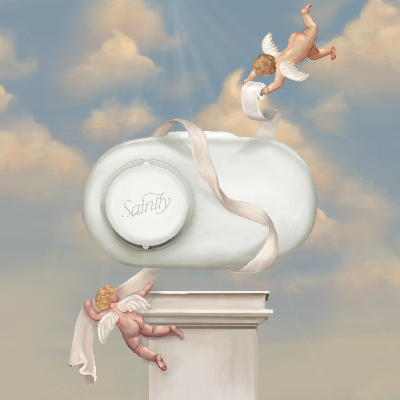
Through its innovative approach to bathroom care, Saintly not only rethinks personal hygiene products but also challenges the stigma that surrounds them, encouraging more open, empowered conversations around cleanliness and self-care. With its category-defining alternative to “flushable” wipes, Saintly fills a critical gap with a product that feels both elevated and considered. Its packaging was thoughtfully engineered to reduce excess materials while still delivering a premium unboxing experience. The box is designed to ship without an additional mailer, lowering its carbon footprint while maintaining structure, beauty, and shelf appeal. An example of how brands can be both sustainable and delightful, without compromising on either.
Saintly is a cheeky, reverent reminder that even our most routine rituals deserve beautiful design—and a little bit of joy.
Saintly elevates the everyday. In a space dominated by clinical cues and euphemism, it offers a perspective that is crafted, joyful and unashamed. By replacing shame with celebration, the brand invites open conversations about bodies and cleanliness, creating permission to laugh, care and take pride in the most human of rituals.
Its tone of voice centres on ‘The Fresh Prince of Florence’, a Renaissance bon vivant with a bold, loquacious and offbeat charm. This refined yet playful persona ensures the messaging feels sophisticated and unexpected, sidestepping the clichés of the category.
Through its innovative approach to bathroom care, Saintly not only rethinks personal hygiene products but also challenges the stigma that surrounds them, encouraging more open, empowered conversations around cleanliness and self-care. With its category-defining alternative to “flushable” wipes, Saintly fills a critical gap with a product that feels both elevated and considered. Its packaging was thoughtfully engineered to reduce excess materials while still delivering a premium unboxing experience. The box is designed to ship without an additional mailer, lowering its carbon footprint while maintaining structure, beauty, and shelf appeal. An example of how brands can be both sustainable and delightful, without compromising on either.
Saintly is a cheeky, reverent reminder that even our most routine rituals deserve beautiful design—and a little bit of joy.
Insights & Strategy
Research revealed two key insights. First, the hygiene space failed to keep up with shifting consumer values. People were increasingly aware of health, wellness, and sustainability, but “flushable” wipes, once marketed as a convenient upgrade, were being exposed for causing major environmental damage. These wipes often don’t break down, clogging plumbing and contributing to sewer build-up. Consumers were stuck between comfort and consequence — eager for a better solution, but unsure where to turn.
Second, we uncovered a deeper cultural tension. While conversations around bodies have become more open, bowel movements remain taboo, something to apologise for, conceal, or sanitise with sterile branding. And yet culturally, butts have never been bigger. From meme culture to art history, the derrière has long been a source of fascination, especially during the Renaissance when the human form (and the butt in particular) was idealised as a symbol of beauty, vitality, and divine proportion.
This overlap between modern celebration and historical reverence presented a unique creative opportunity: to build a brand that didn’t just acknowledge this fixation, but embraced it. This project became a chance to transform hygiene from something apologetic to something empowering, a meaningful shift in how we approach self-care. Beyond product performance, the brand needed to carry a message: that cleanliness is a source of confidence and well-being, not something to be ashamed of.
Second, we uncovered a deeper cultural tension. While conversations around bodies have become more open, bowel movements remain taboo, something to apologise for, conceal, or sanitise with sterile branding. And yet culturally, butts have never been bigger. From meme culture to art history, the derrière has long been a source of fascination, especially during the Renaissance when the human form (and the butt in particular) was idealised as a symbol of beauty, vitality, and divine proportion.
This overlap between modern celebration and historical reverence presented a unique creative opportunity: to build a brand that didn’t just acknowledge this fixation, but embraced it. This project became a chance to transform hygiene from something apologetic to something empowering, a meaningful shift in how we approach self-care. Beyond product performance, the brand needed to carry a message: that cleanliness is a source of confidence and well-being, not something to be ashamed of.
Execution
In a category dominated by sterile packaging, clinical language and euphemistic branding, we saw an opportunity to disrupt it with a concept both richly expressive and unapologetically honest.
Inspired by the phrase “cleanliness is next to godliness”, the strategy imagined a brand world where divine freshness meets Renaissance grandeur. At its core is ‘Heavenly Fresh’, a guiding idea that elevates cleanliness from a feeling, but as a higher state of being.
From this flowed a cohesive naming and design system rooted in Renaissance references, balancing grandeur with humour. Central to the identity is the Saintly wordmark — a custom adaptation of Romie by Margot Lévêque — featuring an upward slant and softened, droplet-like terminals that subtly nod to the product’s function. The mark feels refined yet playful, setting the tone for a brand that is sculptural as well as cheeky. Supporting this is the Saintly “S” monogram, a compact swirl that distils high design and lowbrow wit into a distinctive, ownable icon.
The typographic system expands on Romie, a contemporary serif with elegant glyphs and calligraphic flourishes. Referencing layouts from early Italian printing presses, it brings hierarchy and timeless structure across communications.
The colour palette reinforces the narrative. Inspired by the raw materials of the ritual — earthy browns, golden yellows and creamy neutrals — it evokes warmth and grounded elegance. Tones often avoided in hygiene branding are embraced and reframed to feel premium and refreshingly unfiltered.
Illustration anchors the brand world. A bespoke fresco, ‘The Lake of Revitalisation’, depicts manicured flowerbeds, butt-shaped hedges, toilet roll statues and doves delivering laundered linen. Blending Renaissance motifs with playful scatology, it transforms a bathroom product into a cultural artefact — balancing humour with narrative depth.
Inspired by the phrase “cleanliness is next to godliness”, the strategy imagined a brand world where divine freshness meets Renaissance grandeur. At its core is ‘Heavenly Fresh’, a guiding idea that elevates cleanliness from a feeling, but as a higher state of being.
From this flowed a cohesive naming and design system rooted in Renaissance references, balancing grandeur with humour. Central to the identity is the Saintly wordmark — a custom adaptation of Romie by Margot Lévêque — featuring an upward slant and softened, droplet-like terminals that subtly nod to the product’s function. The mark feels refined yet playful, setting the tone for a brand that is sculptural as well as cheeky. Supporting this is the Saintly “S” monogram, a compact swirl that distils high design and lowbrow wit into a distinctive, ownable icon.
The typographic system expands on Romie, a contemporary serif with elegant glyphs and calligraphic flourishes. Referencing layouts from early Italian printing presses, it brings hierarchy and timeless structure across communications.
The colour palette reinforces the narrative. Inspired by the raw materials of the ritual — earthy browns, golden yellows and creamy neutrals — it evokes warmth and grounded elegance. Tones often avoided in hygiene branding are embraced and reframed to feel premium and refreshingly unfiltered.
Illustration anchors the brand world. A bespoke fresco, ‘The Lake of Revitalisation’, depicts manicured flowerbeds, butt-shaped hedges, toilet roll statues and doves delivering laundered linen. Blending Renaissance motifs with playful scatology, it transforms a bathroom product into a cultural artefact — balancing humour with narrative depth.
Results
No results available yet
2026 Awards
Total Points: 3
Merit Honor

Credits
Design Firm
Universal Favourite / Sydney
Double Up Studio / Stockholm
Copywriter
Cat Wall
Creative Director
Ali Ozden
Designer
Sherry Wang
Executive Creative Director
Dari Israelstam
Illustrator
Sherry Wang
Strategist
Danish Chan
Typographer
Margot Lévêque
Client Services Director
Laura Brown
Related Awards