The One Show
The One Show is the world's most prestigious award show in advertising and design. For over 50 years, the Gold Pencil has been regarded as one of the top prizes in the creative industry. The One Show has a rich legacy of honoring some of the most groundbreaking ideas, created by some of the most remarkable minds in creativity.
Learn more about The One Show 2026
You have exceeded your allotted number of views.
For full access to our extensive awards archive
Members Login Here
For full access to our extensive awards archive
Members Login Here
Category
Creative Use of Data
Annual ID
OS25_AI013M
Background
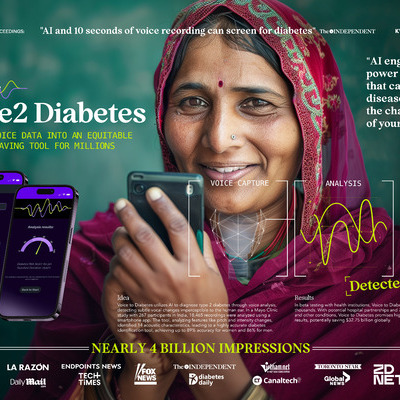
India ranks second globally in diabetes cases, with over half remaining undiagnosed due to barriers like distance, cost, and lack of resources. Leveraging the widespread use of mobile phones among over a billion Indian citizens, Voice 2 Diabetes addresses healthcare disparities and gender equality concerns. This innovative AI tool screens for Type 2 diabetes through voice analysis, offering a non-invasive alternative to traditional blood tests. The study, featured in a Mayo Clinic journal, involved 267 Indian participants. Using a smartphone app, participants recorded voice clips over two weeks, leading to the identification of 14 key acoustic characteristics. For women, pitch changes were vital, while for men, variations in voice strength mattered. Achieving up to 89% accuracy for women and 86% for men, this approach promises a cost-effective and accessible diabetes screening solution, potentially transforming healthcare access in India.
Creative Idea
India is home to the second-largest number of diabetes patients in the world. Despite the staggering number of diabetes cases, more than half remain undiagnosed due to various factors including distance, cost, and lack of resources. India’s vast geographical expanse and uneven distribution of healthcare facilities make accessing diagnostic tests challenging for millions, especially in rural areas. The cost of healthcare, including blood tests, can be prohibitive for many Indians, leading to delayed or neglected health concerns. However, over a billion people living in India have mobile phones. With Voice 2 Diabetes, the widespread use of mobile phones across socioeconomic strata can now be leveraged to address healthcare disparities and save lives.
Insights & Strategy
The strategy behind this innovation was to develop a diabetes screening tool that outsmarts barriers to access in order to help more undiagnosed individuals. Our target audience is for individuals who lack access to diagnostic blood tests due to various barriers, but still have access to a mobile phone. The study, featured in a Mayo Clinic journal, involved 267 Indian participants. Using a smartphone app, participants recorded voice clips over two weeks, leading to the identification of 14 key acoustic characteristics. For women, pitch changes were vital, while for men, variations in voice strength mattered. Achieving up to 89% accuracy for women and 86% for men, this approach promises a cost-effective and accessible diabetes screening solution, potentially transforming healthcare access in India.
Execution
The inspiration for Voice 2 Diabetes stemmed from a recognition of the limitations and inconveniences associated with traditional methods of diagnosing Type 2 diabetes. These methods typically involve invasive blood work, which can be uncomfortable, time-consuming, and costly for patients. Additionally, accessibility to healthcare services might be a challenge for some individuals, especially in remote or underserved areas.
Leveraging AI and machine learning, Voice 2 Diabetes detects subtle vocal changes imperceptible to the human ear, including pitch and intensity alterations. This innovation addresses the inconvenience and discomfort associated with traditional diagnostic methods, offering a more accessible and efficient solution. By tapping into advancements in audio technology, Voice 2 Diabetes represents a paradigm shift in healthcare, demonstrating the potential of disruptive innovation to transform diagnostic practices and improve patient outcomes.
Leveraging AI and machine learning, Voice 2 Diabetes detects subtle vocal changes imperceptible to the human ear, including pitch and intensity alterations. This innovation addresses the inconvenience and discomfort associated with traditional diagnostic methods, offering a more accessible and efficient solution. By tapping into advancements in audio technology, Voice 2 Diabetes represents a paradigm shift in healthcare, demonstrating the potential of disruptive innovation to transform diagnostic practices and improve patient outcomes.
Results
The study, published in a Mayo Clinic journal, involved 267 participants in India, with 192 without diabetes and 75 with a prior diagnosis. Using a smartphone app, participants recorded short voice clips multiple times daily for two weeks. We analyzed 18,465 recordings, identifying 14 different acoustic characteristics that led to the creation of a highly accurate diabetes identification tool. For women, changes in pitch and deviation from the average pitch were crucial, while for men, the diagnosis relied on variations in voice strength or amplitude. With an accuracy of up to 89% for women and 86% for men, this innovative approach could pave the way for an accurate, low-cost, and accessible test for diabetes.
The project generated over four billion earned press impressions, including more than 200 broadcast segments. It was covered in more than 65 countries worldwide, including the U.S. Canada, the UK, Japan, China, Germany, France, and Brazil.
Voice 2 Diabetes technology is already being used in several countries and has been recently approved by Health Canada as a Class 1 Software as a Medical Device (SaMD).
The project generated over four billion earned press impressions, including more than 200 broadcast segments. It was covered in more than 65 countries worldwide, including the U.S. Canada, the UK, Japan, China, Germany, France, and Brazil.
Voice 2 Diabetes technology is already being used in several countries and has been recently approved by Health Canada as a Class 1 Software as a Medical Device (SaMD).
2025 Awards
Total Points: 3

Merit

Credits
Agency
Klick Health / Toronto
Chief Creative Officer
Rich Levy
Executive Creative Director
Bernardo Romero
Tim Jones
Group Creative Director
Amy Fortunato
Andrea Bistany
Director, Communications
Marisa McWilliams
Engineering Lead
Anirudh Thommandram
Manager, Communications
Amanda Ferguson
Scientist
Jaycee Kaufman
Senior Associate Creative Producer
Holly Phipps
SVP, Communications
Sheryl Steinberg
SVP, Digital Health R&D
Yan Fossat
Related Awards