The One Show
The One Show is the world's most prestigious award show in advertising and design. For over 50 years, the Gold Pencil has been regarded as one of the top prizes in the creative industry. The One Show has a rich legacy of honoring some of the most groundbreaking ideas, created by some of the most remarkable minds in creativity.

Category
Green Pencil
Annual ID
OS26_GP004M
Background
Bangladesh’s ceramics industry has expanded rapidly over the past decade, driven by domestic demand for construction materials and tiles. Large-scale manufacturers recycle water to reduce consumption, but this process generates a calcium-rich sludge composed primarily of inert minerals. This by-product cannot be discharged into landfills due to its potential to alter soil composition, disrupt microbial life, and enter waterways through seepage. As a result, factories face rising storage, treatment, and compliance costs associated with managing thousands of tons of sludge annually.
Parallel to this industrial challenge, the country’s education sector faces increasing pressure caused by inflation in imported chalk-grade materials. Chalk production in Bangladesh historically depended on calcium carbonate imports, but Bangladesh Bank data shows prices rising significantly between 2020 and 2025, averaging 8.12 percent inflation annually. This pushed several small chalk factories toward closure, reducing supply and increasing prices for rural schools that rely on traditional chalk-and-slate learning.
The lack of affordable chalk forced schools—especially in low-resource areas—to shift to disposable markers, pens, and paper notebooks. These alternatives increased plastic and paper waste while imposing higher recurring costs on families and institutions. At the same time, the closure of chalk factories meant the loss of local livelihoods linked to manufacturing.
The challenge was systemic: the ceramics industry needed a sustainable alternative to sludge disposal, while primary schools needed affordable, environmentally safe learning materials. The opportunity lay in the overlooked chemical overlap between sludge’s calcium carbonate and chalk’s primary ingredient. This insight created the foundation for TileChalk, an initiative designed to transform waste into a nationally meaningful educational resource while addressing the environmental pressures created by conventional disposal practices.
Parallel to this industrial challenge, the country’s education sector faces increasing pressure caused by inflation in imported chalk-grade materials. Chalk production in Bangladesh historically depended on calcium carbonate imports, but Bangladesh Bank data shows prices rising significantly between 2020 and 2025, averaging 8.12 percent inflation annually. This pushed several small chalk factories toward closure, reducing supply and increasing prices for rural schools that rely on traditional chalk-and-slate learning.
The lack of affordable chalk forced schools—especially in low-resource areas—to shift to disposable markers, pens, and paper notebooks. These alternatives increased plastic and paper waste while imposing higher recurring costs on families and institutions. At the same time, the closure of chalk factories meant the loss of local livelihoods linked to manufacturing.
The challenge was systemic: the ceramics industry needed a sustainable alternative to sludge disposal, while primary schools needed affordable, environmentally safe learning materials. The opportunity lay in the overlooked chemical overlap between sludge’s calcium carbonate and chalk’s primary ingredient. This insight created the foundation for TileChalk, an initiative designed to transform waste into a nationally meaningful educational resource while addressing the environmental pressures created by conventional disposal practices.
Creative Idea
The creative idea behind TileChalk was to transform an industrial waste stream into a safe, essential educational tool—creating the world’s first classroom chalk made from ceramic waste certified non-toxic by government authorities. Rather than treating sludge as a disposal burden, the project reframed it as a raw material with chemical properties similar to traditional chalk powder. This rethinking unlocked a sustainable pathway connecting two unrelated sectors: ceramics and education.
The idea extended beyond chalk. Broken tiles produced during manufacturing and quality checks were repurposed into durable classroom slates, offering a reusable alternative to paper notebooks. The creative leap was recognizing that a problem for one industry could become a solution for another, enabling a circular model where waste becomes value.
TileChalk was intentionally designed to be open source. Instead of building a proprietary model, the project empowered small chalk manufacturers by inviting them into the process, sharing the formula, and supplying sludge free of cost. This approach built distributed ownership, ensuring the solution could scale rapidly and gain acceptance across communities.
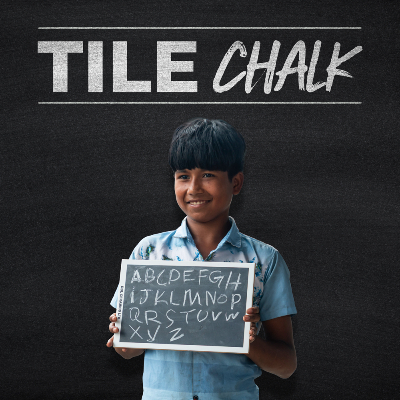
Communication around TileChalk was crafted to emphasize transparency and human impact. The visual narrative juxtaposed heavy industrial sludge with the delicate act of a child writing their first letters. This created an emotional bridge between environmental responsibility and educational opportunity. Messaging was restrained and factual, avoiding overclaiming and focusing instead on verified impact and measurable environmental benefits.
The creative idea ultimately operates on three fronts: ecological regeneration, education access, and industry revival. By transforming waste into a tool for learning, TileChalk demonstrates how circular design can reshape both production systems and social outcomes, creating a blueprint that other industries can replicate.
The idea extended beyond chalk. Broken tiles produced during manufacturing and quality checks were repurposed into durable classroom slates, offering a reusable alternative to paper notebooks. The creative leap was recognizing that a problem for one industry could become a solution for another, enabling a circular model where waste becomes value.
TileChalk was intentionally designed to be open source. Instead of building a proprietary model, the project empowered small chalk manufacturers by inviting them into the process, sharing the formula, and supplying sludge free of cost. This approach built distributed ownership, ensuring the solution could scale rapidly and gain acceptance across communities.
Communication around TileChalk was crafted to emphasize transparency and human impact. The visual narrative juxtaposed heavy industrial sludge with the delicate act of a child writing their first letters. This created an emotional bridge between environmental responsibility and educational opportunity. Messaging was restrained and factual, avoiding overclaiming and focusing instead on verified impact and measurable environmental benefits.
The creative idea ultimately operates on three fronts: ecological regeneration, education access, and industry revival. By transforming waste into a tool for learning, TileChalk demonstrates how circular design can reshape both production systems and social outcomes, creating a blueprint that other industries can replicate.
Insights & Strategy
The strategy behind TileChalk originated from a material insight: the calcium carbonate present in ceramic sludge mirrors the main ingredient used in chalk production. This overlap offered a direct substitution pathway and eliminated dependency on imported chalk powder. The discovery allowed the project to address both environmental waste and supply-chain vulnerability simultaneously.
A key behavioral insight informed distribution strategy. Despite growing access to modern learning tools, many rural schools in Bangladesh still rely on chalk-and-slate teaching because it remains the most practical, durable, and electricity-independent method. Their shift to disposable markers was driven not by preference but by the unavailability and rising cost of chalk due to supply disruption. Reintroducing affordable chalk had the potential to immediately reduce plastic waste while improving classroom access to basic educational supplies.
The strategic approach positioned TileChalk as an ecosystem, not a branded product. By partnering with 15 chalk manufacturers—many on the brink of closure—the project strengthened local production capacity rather than centralizing manufacturing. Small factories were given access to raw materials free of charge, enabling them to reduce production costs by nearly 40 percent and stabilize their operations.
Transparency and credibility were prioritized as strategic pillars. Safety was a key concern, so non-toxic certification from government laboratories was obtained early and integrated into messaging. The formula was made open source to invite industry-wide adoption and to prevent perceptions of commercial monopoly. Public showcases allowed journalists, educators, and parents to examine the product firsthand, reinforcing trust and legitimacy.
Strategically, TileChalk was designed to demonstrate measurable, replicable environmental impact—an approach that positioned it as a model not just for one company but for any ceramics manufacturer facing similar waste challenges. This combination of chemical insight, behavioral understanding, and ecosystem thinking shaped a strategy rooted in long-term scalability.
A key behavioral insight informed distribution strategy. Despite growing access to modern learning tools, many rural schools in Bangladesh still rely on chalk-and-slate teaching because it remains the most practical, durable, and electricity-independent method. Their shift to disposable markers was driven not by preference but by the unavailability and rising cost of chalk due to supply disruption. Reintroducing affordable chalk had the potential to immediately reduce plastic waste while improving classroom access to basic educational supplies.
The strategic approach positioned TileChalk as an ecosystem, not a branded product. By partnering with 15 chalk manufacturers—many on the brink of closure—the project strengthened local production capacity rather than centralizing manufacturing. Small factories were given access to raw materials free of charge, enabling them to reduce production costs by nearly 40 percent and stabilize their operations.
Transparency and credibility were prioritized as strategic pillars. Safety was a key concern, so non-toxic certification from government laboratories was obtained early and integrated into messaging. The formula was made open source to invite industry-wide adoption and to prevent perceptions of commercial monopoly. Public showcases allowed journalists, educators, and parents to examine the product firsthand, reinforcing trust and legitimacy.
Strategically, TileChalk was designed to demonstrate measurable, replicable environmental impact—an approach that positioned it as a model not just for one company but for any ceramics manufacturer facing similar waste challenges. This combination of chemical insight, behavioral understanding, and ecosystem thinking shaped a strategy rooted in long-term scalability.
Execution
The execution of TileChalk began with material research. The R&D team spent months testing drying durations, crush sizes, sieving methods, and binder compositions to transform ceramic sludge into safe, dust-free chalk. Once laboratory testing confirmed that the material met non-toxic standards, the production process was systematized: sludge drying, crushing, sieving, and blending with organic binders. Broken tiles were similarly repurposed through cutting, edge-smoothing, and surface finishing to create lightweight slates suitable for small children.
The initiative’s public rollout prioritized transparency. A detailed open-source manual was published online, enabling manufacturers, NGOs, and educators to download and replicate the formula. Website traffic spiked following publication, indicating strong interest from stakeholders across the country. Two ceramic companies adopted the model independently after reviewing the documentation—demonstrating cross-industry influence.
To build manufacturing capability, the team organized knowledge-sharing sessions with small chalk factories. These sessions taught producers how to integrate sludge into their manufacturing workflows, replacing imported chalk powder. Fifteen factories partnered with the initiative, forming a distributed production ecosystem that allowed rapid scaling across different regions.
Distribution was executed in collaboration with NGOs specializing in education access. Organizations including Amal Foundation, Bidyanondo Foundation, It’s Humanity Foundation, and Mojar School delivered TileChalk sets to more than 1,000 underserved schools nationwide, prioritizing communities where chalk shortages were most severe. Each school served an average of 332 students, placing sustainable writing tools in the hands of more than 332,000 children.
The communication approach combined factual clarity with emotional resonance. The launch film, showing the transformation of factory sludge into a child’s first writing tool, generated immediate organic positive sentiment online. Thousands of comments highlighted the simplicity, transparency, and social value of the solution.
TileChalk’s execution blended industrial innovation, community partnership, and open-source scalability to create environmental impact at every stage of production and distribution.
The initiative’s public rollout prioritized transparency. A detailed open-source manual was published online, enabling manufacturers, NGOs, and educators to download and replicate the formula. Website traffic spiked following publication, indicating strong interest from stakeholders across the country. Two ceramic companies adopted the model independently after reviewing the documentation—demonstrating cross-industry influence.
To build manufacturing capability, the team organized knowledge-sharing sessions with small chalk factories. These sessions taught producers how to integrate sludge into their manufacturing workflows, replacing imported chalk powder. Fifteen factories partnered with the initiative, forming a distributed production ecosystem that allowed rapid scaling across different regions.
Distribution was executed in collaboration with NGOs specializing in education access. Organizations including Amal Foundation, Bidyanondo Foundation, It’s Humanity Foundation, and Mojar School delivered TileChalk sets to more than 1,000 underserved schools nationwide, prioritizing communities where chalk shortages were most severe. Each school served an average of 332 students, placing sustainable writing tools in the hands of more than 332,000 children.
The communication approach combined factual clarity with emotional resonance. The launch film, showing the transformation of factory sludge into a child’s first writing tool, generated immediate organic positive sentiment online. Thousands of comments highlighted the simplicity, transparency, and social value of the solution.
TileChalk’s execution blended industrial innovation, community partnership, and open-source scalability to create environmental impact at every stage of production and distribution.
Results
TileChalk demonstrated measurable environmental impact within its first quarter. By converting sludge into chalk, the initiative recycled 360 tons of industrial waste—material that would otherwise require land-intensive storage or costly treatment. Monthly recycling capacity has reached 110 tons, establishing a long-term pathway for reducing waste accumulation. Using sludge as a substitute for imported chalk-grade calcium carbonate led to BDT 100 million in import savings, lowering supply-chain emissions tied to mining, transport, and delivery of raw materials.
The initiative revitalized the struggling chalk industry by reducing production costs by 40 percent for partnering manufacturers. Fifteen factories now operate with stable raw material access, supported by sludge supplied free of cost. This revived local production capacity and increased output to more than 16.1 million sticks within the first three months.
Distribution through partner NGOs delivered TileChalk sets to more than 1,000 underserved schools across Bangladesh, reaching over 332,000 students. Each slate reduces 2.44 kilograms of paper consumption per student per year, translating to significant reductions in raw deforestation-linked material usage when projected across broader adoption.
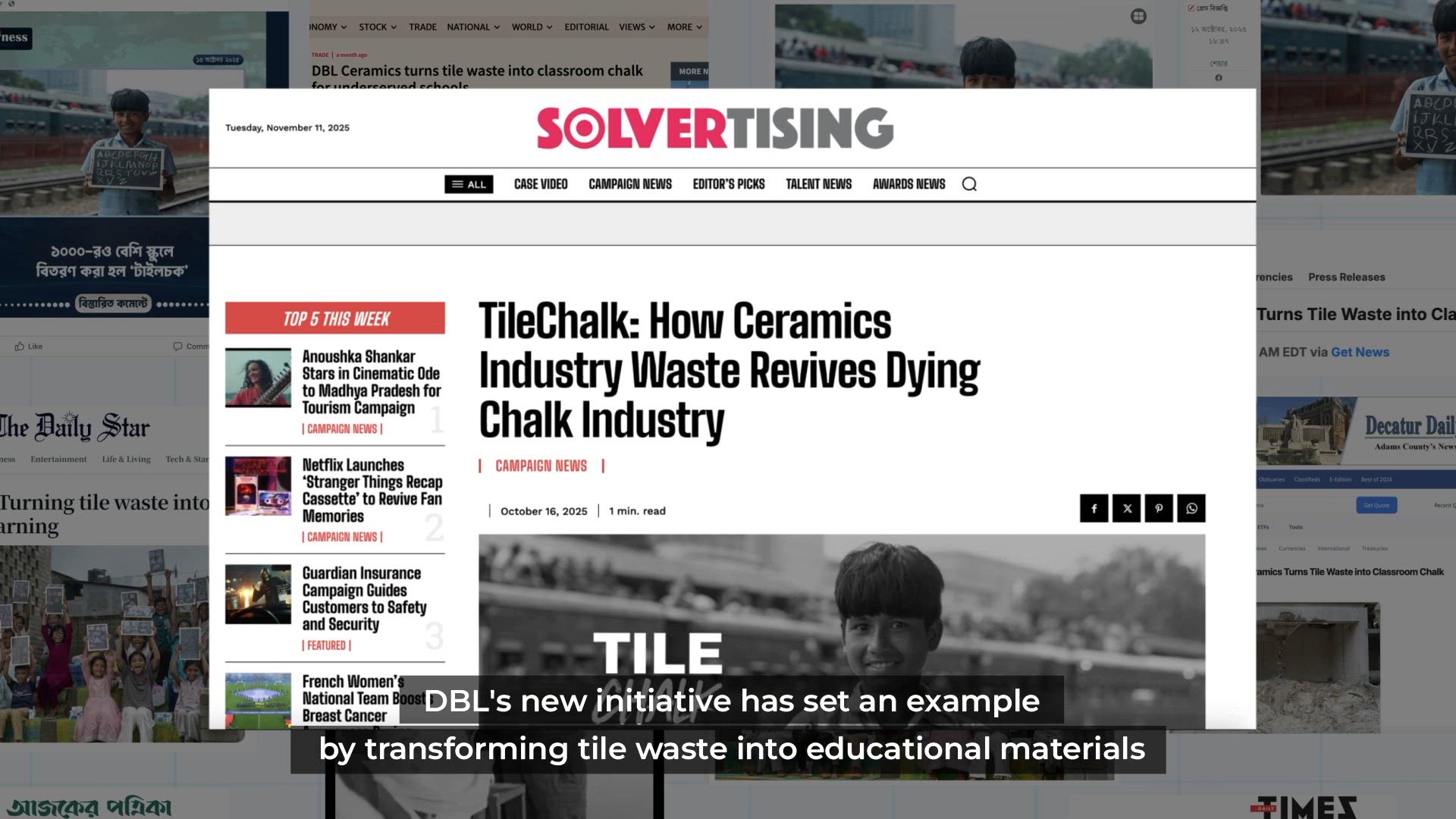
Public response amplified the project’s environmental narrative. The TileChalk film generated over 10 million organic social media impressions, with audiences praising the circular model and its transparent, evidence-based approach. Following the publication of the open-source formula, website traffic surged as manufacturers, educators, and NGOs accessed the documentation. Two additional ceramic factories independently adopted the process, indicating early industry-wide scalability.
The initiative’s environmental model has global relevance. Chalk remains widely used in classrooms across Asia, sub-Saharan Africa, and Latin America. If ceramics manufacturers worldwide were to replicate this approach, millions of tons of industrial waste could be diverted into educational materials annually. TileChalk demonstrates that waste can become a resource—reducing environmental pressure while strengthening learning infrastructures across regions.
The initiative revitalized the struggling chalk industry by reducing production costs by 40 percent for partnering manufacturers. Fifteen factories now operate with stable raw material access, supported by sludge supplied free of cost. This revived local production capacity and increased output to more than 16.1 million sticks within the first three months.
Distribution through partner NGOs delivered TileChalk sets to more than 1,000 underserved schools across Bangladesh, reaching over 332,000 students. Each slate reduces 2.44 kilograms of paper consumption per student per year, translating to significant reductions in raw deforestation-linked material usage when projected across broader adoption.
Public response amplified the project’s environmental narrative. The TileChalk film generated over 10 million organic social media impressions, with audiences praising the circular model and its transparent, evidence-based approach. Following the publication of the open-source formula, website traffic surged as manufacturers, educators, and NGOs accessed the documentation. Two additional ceramic factories independently adopted the process, indicating early industry-wide scalability.
The initiative’s environmental model has global relevance. Chalk remains widely used in classrooms across Asia, sub-Saharan Africa, and Latin America. If ceramics manufacturers worldwide were to replicate this approach, millions of tons of industrial waste could be diverted into educational materials annually. TileChalk demonstrates that waste can become a resource—reducing environmental pressure while strengthening learning infrastructures across regions.
2026 Awards
Total Points: 3

Merit
Credits
Agency
POP5 / Dhaka
Client / Brand
DBL Ceramics Limited / Dhaka
Production Company
Empty Yard / Dhaka
Animator
Khairul Hassan
Art Director
Tahidul Islam
Chief Creative Officer
Mohammad Akrum Hossain
Chief Marketing Officer
Didarul Alam Khan
Copywriter
Nabila Kabir
Zopari Lushai
Director
Bayezid Nil
Director of Photography
Krishna Gopal Basak
MD Kowshikur Rahman
Editor
Muhammad Ullah
Executive Creative Director
Md. Abdullah Al Rana
Md. Tauhidul Azam
Strategy Director
Shahed Muhib
Senior Art Director
Esty Azizul Haque
Senior Copywriter
Mohammad Waleed
S.M. Sohanur Rahman
Admin & HR
Fariha Sultana
Asst. Marketing Manager
Md. Rubaiyat Shafat
Brand Service Director
Shihab Islam Mithun
Chief Business Officer
MD. Bayazed Bashar
Chief Executive Officer
Masud Parvez
Management Trainee - Strategy
Mahmudul Hasan
Managemet Trainee
Sanzida Moon
Marketing Manager
Fairooz Zannat Fannana
Senior Manager-Client Service
Mashrur Majdi
Sr. Executive, Brand Service
Nayma Islam Sneha
Sr. Manager, Event & Activation
M. Morshed Alam
Visualizer
Khairul Islam
Related Awards