The One Show
The One Show is the world's most prestigious award show in advertising and design. For over 50 years, the Gold Pencil has been regarded as one of the top prizes in the creative industry. The One Show has a rich legacy of honoring some of the most groundbreaking ideas, created by some of the most remarkable minds in creativity.

Category
Sustainable Development Goals
Annual ID
OS26_SD003M
Background
Bangladesh’s ceramics industry produces significant quantities of sludge as a by-product of water recycling systems used in tile manufacturing. This sludge, rich in calcium carbonate, cannot be disposed of in landfills due to its potential to disrupt soil composition and contaminate surrounding waterways. As production volumes increased, so did the accumulation of sludge—reaching nearly 1,200 tons annually. Storing and managing this waste became both an environmental responsibility and an operational burden.
At the same time, Bangladesh’s education sector faces recurring challenges in access to affordable classroom materials. Chalk remains a primary teaching tool in many rural and underserved regions where electricity, digital devices, and modern writing surfaces are unavailable. But rising global prices for chalk-grade calcium carbonate drastically increased the cost of manufacturing locally. Bangladesh Bank inflation statistics show an average annual increase of 8.12 percent between 2020 and 2025, placing financial strain on small chalk producers. Several factories either reduced output or shut down entirely, limiting supply for schools.
As chalk prices rose, teachers and institutions—especially in low-resource settings—shifted to disposable markers and pens. These alternatives introduced plastic waste and required frequent replacement, burdening communities with poor waste-management infrastructure. The education sector lacked a sustainable, reliable alternative.
These two challenges—unsustainable industrial waste and dwindling access to affordable classroom tools—created an interlinked problem across sectors. TileChalk was developed as a unified response, aiming to convert industrial by-products into educational resources. By applying material science, community partnerships, and circular thinking, the initiative sought to create environmental, economic, and educational benefits simultaneously.
At the same time, Bangladesh’s education sector faces recurring challenges in access to affordable classroom materials. Chalk remains a primary teaching tool in many rural and underserved regions where electricity, digital devices, and modern writing surfaces are unavailable. But rising global prices for chalk-grade calcium carbonate drastically increased the cost of manufacturing locally. Bangladesh Bank inflation statistics show an average annual increase of 8.12 percent between 2020 and 2025, placing financial strain on small chalk producers. Several factories either reduced output or shut down entirely, limiting supply for schools.
As chalk prices rose, teachers and institutions—especially in low-resource settings—shifted to disposable markers and pens. These alternatives introduced plastic waste and required frequent replacement, burdening communities with poor waste-management infrastructure. The education sector lacked a sustainable, reliable alternative.
These two challenges—unsustainable industrial waste and dwindling access to affordable classroom tools—created an interlinked problem across sectors. TileChalk was developed as a unified response, aiming to convert industrial by-products into educational resources. By applying material science, community partnerships, and circular thinking, the initiative sought to create environmental, economic, and educational benefits simultaneously.
Creative Idea
The creative idea behind TileChalk was to reimagine ceramic waste as an educational resource, enabling the world’s first classroom chalk made from non-toxic ceramic sludge. Instead of approaching sludge as a disposal problem, the initiative reframed it as a valuable input due to its calcium-rich composition. This shift turned a waste stream into a pathway to support education while reducing environmental impact.
At its core, the idea connects two unrelated systems—industrial manufacturing and primary education—into a single circular model. Sludge becomes chalk; broken tiles become slates. The transformation is both practical and symbolic, demonstrating that sustainable design can empower undervalued communities while addressing industrial challenges.
TileChalk expands the concept of product innovation into ecosystem innovation. Rather than positioning the brand as the sole producer, the project intentionally distributed ownership by sharing its formula openly and inviting small chalk manufacturers to participate. This decentralized model ensures rapid scalability and resilience, enabling local producers to revive their businesses with drastically reduced raw material costs.
The visual concept of TileChalk emphasizes contrasts: the weight of industrial sludge versus the simplicity of a child learning to write; the hardness of tiles versus the softness of chalk on slate. Communication intentionally avoided commercial tone and remained focused on transparency, safety, and measurable impact. Government-issued non-toxic certification became a key component of the creative narrative to address public concerns regarding waste-derived materials.
By merging environmental stewardship with educational access, the creative idea reframes chalk not just as a commodity but as a tool for impact. TileChalk becomes a symbol of what circular economy thinking can achieve—turning industrial residues into instruments of learning, community advancement, and sustainable development.
At its core, the idea connects two unrelated systems—industrial manufacturing and primary education—into a single circular model. Sludge becomes chalk; broken tiles become slates. The transformation is both practical and symbolic, demonstrating that sustainable design can empower undervalued communities while addressing industrial challenges.
TileChalk expands the concept of product innovation into ecosystem innovation. Rather than positioning the brand as the sole producer, the project intentionally distributed ownership by sharing its formula openly and inviting small chalk manufacturers to participate. This decentralized model ensures rapid scalability and resilience, enabling local producers to revive their businesses with drastically reduced raw material costs.
The visual concept of TileChalk emphasizes contrasts: the weight of industrial sludge versus the simplicity of a child learning to write; the hardness of tiles versus the softness of chalk on slate. Communication intentionally avoided commercial tone and remained focused on transparency, safety, and measurable impact. Government-issued non-toxic certification became a key component of the creative narrative to address public concerns regarding waste-derived materials.
By merging environmental stewardship with educational access, the creative idea reframes chalk not just as a commodity but as a tool for impact. TileChalk becomes a symbol of what circular economy thinking can achieve—turning industrial residues into instruments of learning, community advancement, and sustainable development.
Insights & Strategy
The insight driving TileChalk came from understanding that two failing systems could complete each other. The ceramics industry struggled with sludge accumulation, while the chalk industry fought rising import costs. The discovery that ceramic sludge shared the same fundamental component—calcium carbonate—as chalk powder revealed a strategic opportunity to create a closed-loop resource model that benefitted both sectors.
A second key insight related to education behavior in Bangladesh. Rural schools continue using chalk because it fits their realities: limited infrastructure, sporadic electricity, and large class sizes. Their shift to disposable markers was a consequence of declining local chalk supply, not evolving preferences. Restoring an affordable chalk ecosystem would immediately reduce plastic waste and support school budgets.
Strategically, the project chose distributed production over centralized manufacturing. Small chalk factories, many nearing closure, were invited to knowledge-sharing sessions that taught them how to use sludge as a primary raw material. Fifteen factories formed partnerships, enabling scale and local ownership. By supplying sludge at no cost, the initiative created a long-term incentive for manufacturers to adopt sustainable materials while lowering their production costs by 40 percent.
Transparency was central to the strategy. Open-source publication of the formula encouraged nationwide collaboration and positioned the initiative as a shared movement rather than a proprietary innovation. Safety certification addressed potential concerns about using industrial waste in educational contexts, reinforcing public trust.
The strategy amplified impact through partnerships with NGOs specializing in education access. Their involvement ensured delivery to underserved schools and accelerated community-level adoption. Media engagement, coupled with a purpose-driven launch film, generated a wave of organic support that expanded the initiative’s reach beyond traditional advertising channels.
TileChalk’s strategy leverages material science, community partnerships, and open-source innovation to build a replicable, scalable system rooted in sustainable development.
A second key insight related to education behavior in Bangladesh. Rural schools continue using chalk because it fits their realities: limited infrastructure, sporadic electricity, and large class sizes. Their shift to disposable markers was a consequence of declining local chalk supply, not evolving preferences. Restoring an affordable chalk ecosystem would immediately reduce plastic waste and support school budgets.
Strategically, the project chose distributed production over centralized manufacturing. Small chalk factories, many nearing closure, were invited to knowledge-sharing sessions that taught them how to use sludge as a primary raw material. Fifteen factories formed partnerships, enabling scale and local ownership. By supplying sludge at no cost, the initiative created a long-term incentive for manufacturers to adopt sustainable materials while lowering their production costs by 40 percent.
Transparency was central to the strategy. Open-source publication of the formula encouraged nationwide collaboration and positioned the initiative as a shared movement rather than a proprietary innovation. Safety certification addressed potential concerns about using industrial waste in educational contexts, reinforcing public trust.
The strategy amplified impact through partnerships with NGOs specializing in education access. Their involvement ensured delivery to underserved schools and accelerated community-level adoption. Media engagement, coupled with a purpose-driven launch film, generated a wave of organic support that expanded the initiative’s reach beyond traditional advertising channels.
TileChalk’s strategy leverages material science, community partnerships, and open-source innovation to build a replicable, scalable system rooted in sustainable development.
Execution
Execution of TileChalk began with extensive research and development. The sludge was subjected to multiple cycles of drying, crushing, and sieving to achieve the correct texture and purity. The team experimented with organic binders to ensure the chalk would be dust-free, durable, and safe for classroom use. Once laboratory tests confirmed the product met non-toxic standards, the production process was standardized into a repeatable workflow.
Simultaneously, broken tiles from quality control rejections were transformed into slates. Through cutting, edge grinding, and surface finishing, these tiles were repurposed into lightweight, child-friendly writing boards. The parallel production lines allowed chalk and slates to be packaged together into complete learning sets.
To scale the initiative, a series of onboarding workshops were held for small chalk manufacturers. These sessions covered raw material handling, processing techniques, cost analysis, and quality control. Fifteen factories implemented the new method, integrating sludge-based raw materials into their workflows. This distributed model increased national chalk production capacity while reducing dependence on imported materials.
Distribution relied heavily on partnerships with local NGOs, ensuring that TileChalk sets reached over 1,000 underserved schools. These organizations mapped communities where chalk shortages were most severe and facilitated direct delivery to students. This ensured maximum impact in regions where the need was greatest.
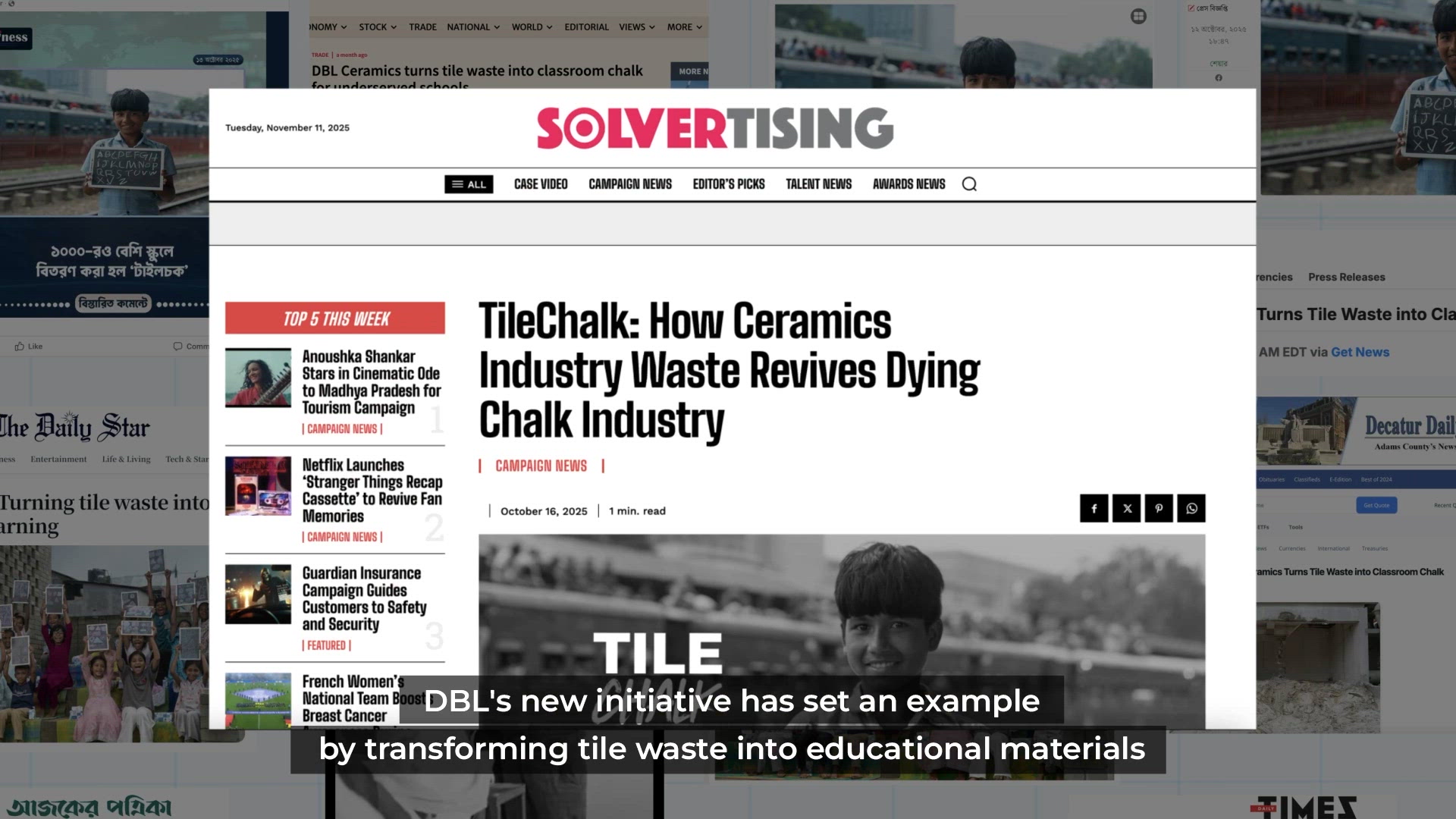
Communication execution centered on authenticity. The TileChalk film documented the transformation from waste to writing tool and emphasized simplicity, transparency, and community benefit. Once published, the film generated significant organic engagement, with thousands praising the initiative’s humanity and innovation.
The formula’s open-source publication drove public trust and industry interest. Increased website traffic confirmed broader engagement, while two additional ceramics companies adopted the model independently. Execution balanced industrial precision, community partnership, and open communication to ensure both credibility and scalability.
Simultaneously, broken tiles from quality control rejections were transformed into slates. Through cutting, edge grinding, and surface finishing, these tiles were repurposed into lightweight, child-friendly writing boards. The parallel production lines allowed chalk and slates to be packaged together into complete learning sets.
To scale the initiative, a series of onboarding workshops were held for small chalk manufacturers. These sessions covered raw material handling, processing techniques, cost analysis, and quality control. Fifteen factories implemented the new method, integrating sludge-based raw materials into their workflows. This distributed model increased national chalk production capacity while reducing dependence on imported materials.
Distribution relied heavily on partnerships with local NGOs, ensuring that TileChalk sets reached over 1,000 underserved schools. These organizations mapped communities where chalk shortages were most severe and facilitated direct delivery to students. This ensured maximum impact in regions where the need was greatest.
Communication execution centered on authenticity. The TileChalk film documented the transformation from waste to writing tool and emphasized simplicity, transparency, and community benefit. Once published, the film generated significant organic engagement, with thousands praising the initiative’s humanity and innovation.
The formula’s open-source publication drove public trust and industry interest. Increased website traffic confirmed broader engagement, while two additional ceramics companies adopted the model independently. Execution balanced industrial precision, community partnership, and open communication to ensure both credibility and scalability.
Results
TileChalk produced measurable outcomes across environmental, educational, and industrial sectors. In its first three months, the initiative recycled 360 tons of ceramic sludge, redirecting it from environmentally hazardous storage sites into productive use. Monthly recycling reached 110 tons, demonstrating a functioning circular waste-management model.
By replacing expensive imported calcium carbonate, the initiative generated BDT 100 million in import savings. This reduced not only financial costs but also the carbon footprint associated with mining and transport of raw materials. Chalk manufacturers who adopted the new formula saw production costs drop by 40 percent, enabling them to stabilize their operations and increase output. Fifteen factories revived production capacity through the initiative.
TileChalk reached more than 1,000 underserved schools, benefitting over 332,000 students based on average enrollment. For these children, the chalk-and-slate sets provided durable, reusable learning tools and reduced reliance on disposable stationery. Each slate saved an estimated 2.44 kilograms of paper per student annually, representing significant reductions in resource consumption across participating schools.
Public response amplified the initiative’s impact. The launch film accumulated over 10 million organic social media impressions, generating widespread positive sentiment. Thousands of comments celebrated the project’s simplicity, transparency, and social value. This organic attention strengthened public understanding of responsible production and circular design.
After the open-source formula was published, website traffic spiked as educators, NGOs, and manufacturers accessed the documentation. Importantly, two additional ceramics companies adopted the method independently—demonstrating early-phase scalability and industry transformation.
If replicated across Bangladesh, TileChalk could recycle thousands of tons of waste annually and produce tens of millions of chalk sticks, reshaping the national supply chain. If adopted by ceramics industries in countries that still use chalk as a primary teaching tool, the model could transform global educational access while significantly reducing industrial waste worldwide.
By replacing expensive imported calcium carbonate, the initiative generated BDT 100 million in import savings. This reduced not only financial costs but also the carbon footprint associated with mining and transport of raw materials. Chalk manufacturers who adopted the new formula saw production costs drop by 40 percent, enabling them to stabilize their operations and increase output. Fifteen factories revived production capacity through the initiative.
TileChalk reached more than 1,000 underserved schools, benefitting over 332,000 students based on average enrollment. For these children, the chalk-and-slate sets provided durable, reusable learning tools and reduced reliance on disposable stationery. Each slate saved an estimated 2.44 kilograms of paper per student annually, representing significant reductions in resource consumption across participating schools.
Public response amplified the initiative’s impact. The launch film accumulated over 10 million organic social media impressions, generating widespread positive sentiment. Thousands of comments celebrated the project’s simplicity, transparency, and social value. This organic attention strengthened public understanding of responsible production and circular design.
After the open-source formula was published, website traffic spiked as educators, NGOs, and manufacturers accessed the documentation. Importantly, two additional ceramics companies adopted the method independently—demonstrating early-phase scalability and industry transformation.
If replicated across Bangladesh, TileChalk could recycle thousands of tons of waste annually and produce tens of millions of chalk sticks, reshaping the national supply chain. If adopted by ceramics industries in countries that still use chalk as a primary teaching tool, the model could transform global educational access while significantly reducing industrial waste worldwide.
2026 Awards
Total Points: 3

Merit
Credits
Agency
POP5 / Dhaka
Client / Brand
DBL Ceramics Limited / Dhaka
Production Company
Empty Yard / Dhaka
Animator
Khairul Hassan
Art Director
Tahidul Islam
Chief Creative Officer
Mohammad Akrum Hossain
Chief Marketing Officer
Didarul Alam Khan
Copywriter
Nabila Kabir
Zopari Lushai
Director
Bayezid Nil
Director of Photography
Krishna Gopal Basak
MD Kowshikur Rahman
Editor
Muhammad Ullah
Executive Creative Director
Md. Abdullah Al Rana
Md. Tauhidul Azam
Strategy Director
Shahed Muhib
Senior Art Director
Esty Azizul Haque
Senior Copywriter
Mohammad Waleed
S.M. Sohanur Rahman
Admin & HR
Fariha Sultana
Asst. Marketing Manager
Md. Rubaiyat Shafat
Brand Service Director
Shihab Islam Mithun
Chief Business Officer
MD. Bayazed Bashar
Chief Executive Officer
Masud Parvez
Management Trainee - Strategy
Mahmudul Hasan
Managemet Trainee
Sanzida Moon
Marketing Manager
Fairooz Zannat Fannana
Senior Manager-Client Service
Mashrur Majdi
Sr. Executive, Brand Service
Nayma Islam Sneha
Sr. Manager, Event & Activation
M. Morshed Alam
Visualizer
Khairul Islam
Related Awards